
Cloud Computing for Business: A Strategic Guide to Digital Transformation
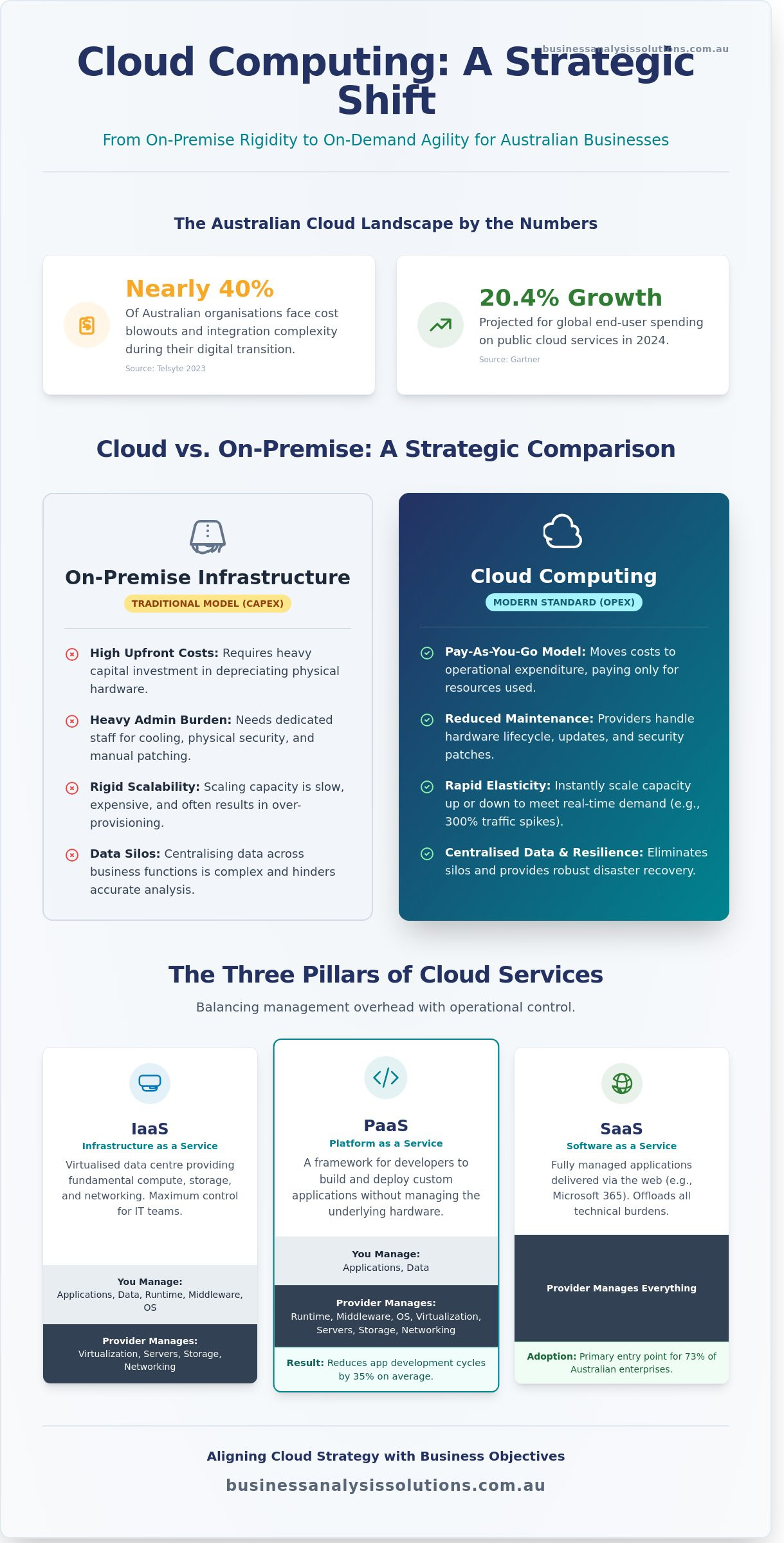
Adopting a cloud-first strategy isn't just a technical preference; it's a fundamental requirement for commercial viability in the Australian market. Despite this, data from Telsyte's 2023 Cloud Ecosystem study indicates that nearly 40% of local organisations struggle with cost blowouts and integration complexities during their digital transition. You're likely aware that rigid legacy systems can't support the agility your stakeholders demand, yet the fear of data breaches and opaque pricing structures often stalls decisive action.
This guide moves beyond technical jargon to establish cloud computing as a precise instrument for business optimization. We'll provide a methodical framework to align your technology roadmap with specific organisational goals, ensuring every A$1 spent on infrastructure delivers measurable returns. You'll gain a clear understanding of deployment models and a structured approach to strategic technology decisions that prioritise both security and operational scalability. We'll conclude with a logical process for bridging the gap between your current technical requirements and future business objectives.
Key Takeaways
Understand the transition from rigid on-premise hardware to elastic, on-demand resources to enhance organizational agility and scalability.
Demystify the technical landscape by evaluating how SaaS, PaaS, and IaaS models provide specific operational advantages for your business.
Leverage cloud computing to drive process automation and improve stakeholder engagement across a distributed Australian workforce.
Address data safety concerns by benchmarking your infrastructure against the Australian Essential 8 framework to ensure robust security and compliance.
Utilize rigorous requirements elicitation and a Digital Transformation Blueprint to align your technology investments with core strategic objectives.
Table of Contents What is Cloud Computing in a Business Context? The Three Pillars: Understanding SaaS, PaaS, and IaaS Strategic Benefits of Cloud Adoption for Australian Organisations Navigating Cloud Security and Compliance Requirements Aligning Cloud Strategy with Business Objectives
What is Cloud Computing in a Business Context?
In a commercial environment, cloud computing represents the on-demand delivery of ICT resources via the internet, replacing the necessity for local server infrastructure. It's a fundamental shift from owning physical assets to consuming services as they're required. Traditional on-premise hardware demands heavy upfront capital investment. Cloud environments offer an elastic alternative where resources scale in alignment with real-time demand. This transition moves technical costs from capital expenditure (CapEx) to operational expenditure (OpEx), allowing firms to pay only for the capacity they use.
Gartner reports that global end-user spending on public cloud services is projected to grow 20.4% in 2024. For Australian firms, this means replacing depreciating server rooms with scalable, high-performance environments that drive strategic outcomes. It's the foundation for modern business efficiency. By removing the constraints of physical hardware, organisations gain the agility needed to respond to market shifts with precision.
The Core Characteristics of Cloud Services
Effective digital strategy relies on three functional pillars. First, on-demand self-service allows teams to provision computing power or storage without manual intervention from service providers. Second, broad network access ensures stakeholders engage with critical systems from any location. This is vital given that 40% of Australians worked from home regularly according to 2023 Australian Bureau of Statistics data. Finally, rapid elasticity enables a firm to scale capacity instantly. If a retail platform sees a 300% spike in traffic during a promotion, the infrastructure expands to meet that load and contracts afterward to maintain cost efficiency.
Cloud vs. On-Premise: A Strategic Comparison
Maintaining physical servers introduces a heavy administrative burden and hidden costs. On-premise systems require dedicated cooling, physical security, and manual patching. Cloud infrastructure mitigates these risks through managed services. Automated backups and disaster recovery protocols provide a level of resilience that 68% of small-to-medium enterprises struggle to achieve independently. This transition fosters seamless integration across business functions. By centralising data, organisations eliminate silos and ensure that process mapping and requirements elicitation are based on a single, accurate source of truth.
Reduced Maintenance: Providers handle hardware lifecycle management and security updates.
Operational Reliability: Redundant data centres ensure uptime that exceeds standard local capabilities.
Strategic Alignment: Technical resources are redirected toward high-value business analysis and growth.
The Three Pillars: Understanding SaaS, PaaS, and IaaS
Selecting the appropriate cloud computing model requires a clear understanding of the trade-off between management overhead and operational control. Business leaders must evaluate these models as strategic levers that determine how internal ICT resources are allocated. The three primary service models represent a spectrum of responsibility that shifts from the provider to the client as the architecture becomes more granular. This logical progression allows for strategic alignment between technical capabilities and commercial goals.
Software as a Service (SaaS): The User Layer
SaaS delivers fully managed applications via the web, removing the need for local installation or maintenance. This model serves as the primary entry point for 73% of Australian enterprises undergoing digital transformation because it enables rapid deployment without significant upfront capital expenditure. Common examples include Microsoft 365 for productivity and Salesforce for CRM. By adopting SaaS, organisations offload the burden of security patching and version control to the vendor. This shift allows internal teams to focus on stakeholder engagement and process optimisation rather than software upkeep.
Infrastructure and Platform Models (IaaS & PaaS)
Infrastructure as a Service (IaaS) provides the fundamental building blocks of compute, storage, and networking. It's a virtualised data centre where the business retains control over the operating system and middleware. Platform as a Service (PaaS) offers a framework for developers to build and deploy custom applications without managing the underlying hardware. Microsoft Azure provides both capabilities, allowing businesses to scale resources based on real-time demand. A 2023 industry report found that Australian firms using PaaS reduced application development cycles by 35% on average.
Choosing between these models depends on organisational maturity and specific ICT needs. While the provider secures the physical infrastructure, the business remains responsible for data governance and access management. This is known as the shared responsibility model. For companies struggling to define these boundaries, a professional requirements elicitation process can ensure the chosen cloud computing model meets specific operational objectives.
SaaS: Best for standard business functions like ERP, CRM, or communication tools.
PaaS: Ideal for custom software development and automating complex business workflows.
IaaS: Suited for hosting legacy systems or high-performance computing tasks requiring maximum control.
Strategic Benefits of Cloud Adoption for Australian Organisations
Cloud computing transforms how Australian enterprises manage operational overhead. By automating manual workflows, organisations reduce human error and reallocate talent to high-value analysis. A 2023 study by Telsyte revealed that 45% of Australian organisations now prioritise cloud migration to improve business agility. This shift enables robust stakeholder engagement across dispersed geographic locations. It empowers a remote workforce to access critical systems without the latency issues common in legacy on-premise setups.
Strategic alignment occurs when technology spend mirrors actual business growth. Instead of heavy upfront capital expenditure (CapEx), firms adopt an operational expenditure (OpEx) model. This ensures every A$ spent on ICT infrastructure directly supports current requirements. It also provides immediate access to advanced tools like Power BI and AI-driven predictive modelling. These solutions allow businesses to stay competitive without the burden of maintaining physical data centres. It's a pragmatic approach to modernising a balance sheet.
Operational Flexibility and Scalability
Scaling a business used to require months of hardware procurement and server room upgrades. Now, cloud infrastructure allows for near-instant resource allocation. Australian retailers often see traffic spikes exceeding 300% during November Black Friday events; the cloud manages this load automatically. This elasticity eliminates the friction of physical constraints. It also addresses technical debt directly. Continuous updates from providers ensure your stack remains modern, which removes the need for periodic, costly infrastructure overhauls.
Data-Driven Decision Making
Clarity is the primary output of cloud-based analytics. Integrated communication services allow real-time reporting across all departments. This bridges the gap between raw data and actionable insights. According to 2024 industry benchmarks, data-driven organisations are significantly more likely to outperform their peers in customer acquisition. Using Power BI within a cloud computing environment enables leaders to visualise complex datasets instantly. This creates a logical path from observation to strategic execution. It doesn't just offer data; it offers direction.
Navigating Cloud Security and Compliance Requirements
Data security remains the primary barrier for 62% of Australian executives considering a full migration. While concerns about external breaches are valid, logical business analysis reveals that internal process gaps often pose the greater risk. Professional requirements elicitation identifies these vulnerabilities before any data moves. Data sovereignty is equally critical; Australian businesses must ensure their data resides in local data centres to comply with the Privacy Act 1988. This physical location determines which legal jurisdictions apply to your corporate intelligence. It's vital to verify that your provider maintains an Australian presence to avoid international legal complexities.
The Essential 8 and Cloud Governance
Effective cloud computing strategies align with the Australian Signals Directorate (ASD) Essential 8 framework. Leading providers facilitate compliance by automating patch management and providing integrated multi-factor authentication (MFA) tools. Our methodology ensures these technical controls meet specific regulatory standards, such as CPS 234 for financial services. By mapping current state processes against these benchmarks, we eliminate the ambiguity that leads to compliance failures. Implementing the Essential 8 isn't a one-time event; it's a continuous cycle of assessment and refinement that we integrate into your governance model.
Risk Mitigation and Disaster Recovery
Traditional physical storage carries a 15% higher risk of total data loss compared to geo-redundant cloud solutions. A structured digital strategy incorporates automated recovery protocols that reduce Downtime Cost (DTC) from an average of A$12,500 per hour to near zero. We act as your Trusted Advisor to audit vendor security postures and verify that disaster recovery plans are functional rather than theoretical. This methodical approach ensures business continuity regardless of hardware failure or regional disruptions. It's not just about storage; it's about organisational resilience.
Secure your organisational future by booking a strategic security gap analysis today.
Aligning Cloud Strategy with Business Objectives
Cloud success isn't defined by the specific software vendor you choose. It's determined by how well the technology serves your commercial goals. Many Australian enterprises rush into cloud computing without first understanding their internal dependencies, which often leads to bloated costs and technical debt. A structured approach begins with a Business Efficiency Diagnostic to identify where manual bottlenecks exist. This diagnostic serves as the evidence base for all future investment. For mid-sized firms, a Fractional CIO provides the high-level oversight needed to ensure technical decisions align with the 5-year growth plan. This role acts as a bridge between the server room and the boardroom, providing clarity without the overhead of a full-time executive.
The Role of Business Analysis in Cloud Migration
Successful migration requires detailed process mapping to ensure the new environment solves existing operational hurdles. Simply moving an inefficient workflow to a digital server, known as the "lift and shift" trap, only digitizes failure. Requirements elicitation is the practice of identifying true stakeholder needs and business constraints before any technology selection occurs. By refining processes before the move, firms often reduce their storage and compute requirements by 20% to 30%. This ensures the cloud environment is lean, functional, and scalable from day one.
Executing Your Digital Transformation Blueprint
The Digital Transformation Blueprint converts a high-level vision into a granular implementation plan with clear milestones. It moves beyond abstract goals to define specific technical architectures and data governance protocols. Rigorous project management is essential here; industry data suggests that 70% of digital initiatives exceed their original timelines when they lack a structured roadmap. A disciplined plan ensures that deployments remain on schedule and within budget. To begin your strategic cloud journey, Request a Business Efficiency Diagnostic to assess your current operational maturity and define a clear path forward.
Securing Your Competitive Advantage through Strategic Cloud Integration
Adopting cloud computing isn't merely a technical upgrade; it's a fundamental shift in how your organisation delivers value. Success hinges on selecting the right service model, whether SaaS, PaaS, or IaaS, and ensuring every technical decision mirrors your commercial objectives. For Australian businesses, navigating the complexities of data sovereignty and the Privacy Act 1988 is essential to maintain stakeholder trust and operational continuity.
Business Analysis Solutions brings over 20 years of industry experience to help you navigate this transition. Our Strategic Digital Transformation Blueprint provides a structured methodology to bridge the gap between complex technical requirements and high-level business goals. We focus on delivering measurable outcomes, often identifying opportunities to improve operational efficiency by up to 30% through precise process mapping and resource allocation.
Don't leave your digital evolution to chance. Book a Strategic Consultation for Your Digital Transformation today to secure a clear path forward. We're ready to help you build a more resilient, scalable future for your business.
Frequently Asked Questions
What is the difference between public, private, and hybrid cloud?
Public cloud uses shared infrastructure managed by third-party providers like AWS or Azure, while private cloud is a dedicated environment reserved for a single organisation. Hybrid cloud combines both, allowing data and applications to move between environments as needs change. Telsyte's 2023 Cloud Market Study shows that 45% of Australian enterprises now adopt a hybrid model. This strategy balances the cost-efficiency of public services with the strict control of private infrastructure.
How much does cloud computing cost for a medium-sized business?
A medium-sized Australian business with 50 to 100 employees typically spends between A$3,000 and A$8,500 per month on cloud computing services. These costs cover infrastructure as a service (IaaS) and essential software subscriptions. Actual expenditure varies based on data storage volume and compute intensity. Logic-driven budgeting should include a 15% buffer to manage variable data egress fees during the first 90 days of operation.
Can we move our legacy software to the cloud?
You can move legacy software to the cloud using strategies such as rehosting or refactoring. Rehosting moves the application without code changes, while refactoring involves modifying the software to suit cloud-native environments. Gartner research indicates that 70% of legacy applications require some level of refactoring to achieve optimal performance. We recommend a thorough requirements elicitation phase to identify which applications will deliver the highest return on investment.
Is cloud computing more secure than on-premise servers?
Cloud environments are generally more secure than on-premise servers because global providers invest billions in advanced threat detection and physical security. Microsoft spends approximately A$1.5 billion annually on cybersecurity measures that most Australian businesses cannot replicate. Statistics show that 94% of companies report a security improvement after migrating. While the provider secures the infrastructure, your business remains responsible for managing internal access controls and data governance.
What happens to our business if the internet goes down?
Operations for cloud-dependent tasks will pause during an internet outage unless you've implemented offline synchronization or redundant connections. Most Australian businesses mitigate this risk by using NBN Enterprise Ethernet, which provides a 99.95% uptime guarantee. You should also maintain a secondary 4G or 5G failover link. A 2023 industry report found that 82% of Australian firms now use dual-path connectivity to ensure continuous access to their digital assets.
How do we choose the right cloud provider for our specific industry?
Choosing a provider requires aligning their technical capabilities with your specific regulatory and operational requirements. For example, Australian financial services often select Azure because it meets local APRA compliance standards. You must evaluate data residency to ensure your information stays within Australian borders. We find that 65% of successful migrations start with a detailed process mapping exercise to match provider features with specific business objectives.
Do we need a Fractional CIO to manage our cloud transition?
Engaging a Fractional CIO is a strategic decision that helps manage the technical complexities and cost controls of a cloud computing transition. These experts provide high-level guidance without the expense of a full-time executive. Data indicates that organisations using a Fractional CIO reduce cloud-related waste by 28% through precise resource allocation. They bridge the gap between technical requirements and business outcomes, ensuring the migration supports your long-term growth.
How long does a typical cloud migration project take?
A typical cloud migration for a medium-sized organisation takes between 3 and 9 months to complete. This timeline includes discovery, planning, data transfer, and staff training phases. A 2022 survey of Australian IT managers found that 54% of projects for companies with 100 staff members reached full implementation within 6 months. Rushing this process often leads to configuration errors. A methodical, phased approach ensures seamless integration and minimal disruption to operations.



Comments