
Fractional CIO Services Australia: The 2026 Strategic Leadership Guide
Updated: Mar 20
An IT budget that consistently exceeds its forecast by 22% isn't just a management challenge; it's a direct threat to your 2026 profitability. Most mid-market leaders recognize that their current technology trajectory is unsustainable, yet they remain tethered to legacy systems that drain resources. You've likely experienced the anxiety of trying to meet the Australian Cyber Security Centre’s Essential 8 requirements while your core projects stall. It's a common scenario where technical debt accumulates and vendor lock-in limits your agility. Engaging fractional CIO services Australia offers a logical path forward, providing the high-level expertise needed to bridge the gap between complex infrastructure and commercial outcomes without the A$320,000 price tag of a full-time hire.
This guide provides a structured methodology to help you regain control of your digital assets and eliminate wasteful spending. You'll discover how to build a technology roadmap that prioritizes strategic alignment and operational efficiency. We'll examine the specific frameworks for implementing AI and automation while ensuring your cybersecurity posture remains robust against evolving threats.
Key Takeaways
Understand why Australian mid-market firms are pivoting to fractional models to secure executive-level IT leadership without the prohibitive overhead of a full-time C-suite salary.
Learn why successful digital transformation begins with rigorous business analysis and process mapping rather than software procurement to ensure technical investments drive commercial objectives.
Identify the critical distinctions between Managed IT (MSP) operational support and Fractional CIO services Australia, focusing on high-level strategy, governance, and long-term business efficiency.
Discover a structured 5-step execution plan designed to align your ICT goals with a 3-5 year business strategy through diagnostic assessments and strategic alignment.
Gain insights into how leveraging senior-level consulting and a boutique approach provides the precision needed to untangle organizational complexities and deliver measurable ROI.
Table of Contents What is a Fractional CIO and Why is Australia Seeing a 2026 Surge? The Foundation of Success: Why Business Analysis Precedes Technology Fractional CIO vs. Managed IT Services: Navigating the Australian Tech Landscape Building Your Digital Transformation Blueprint: A 5-Step Execution Plan Strategic ICT Leadership: Partnering with Business Analysis & Solutions
What is a Fractional CIO and Why is Australia Seeing a 2026 Surge?
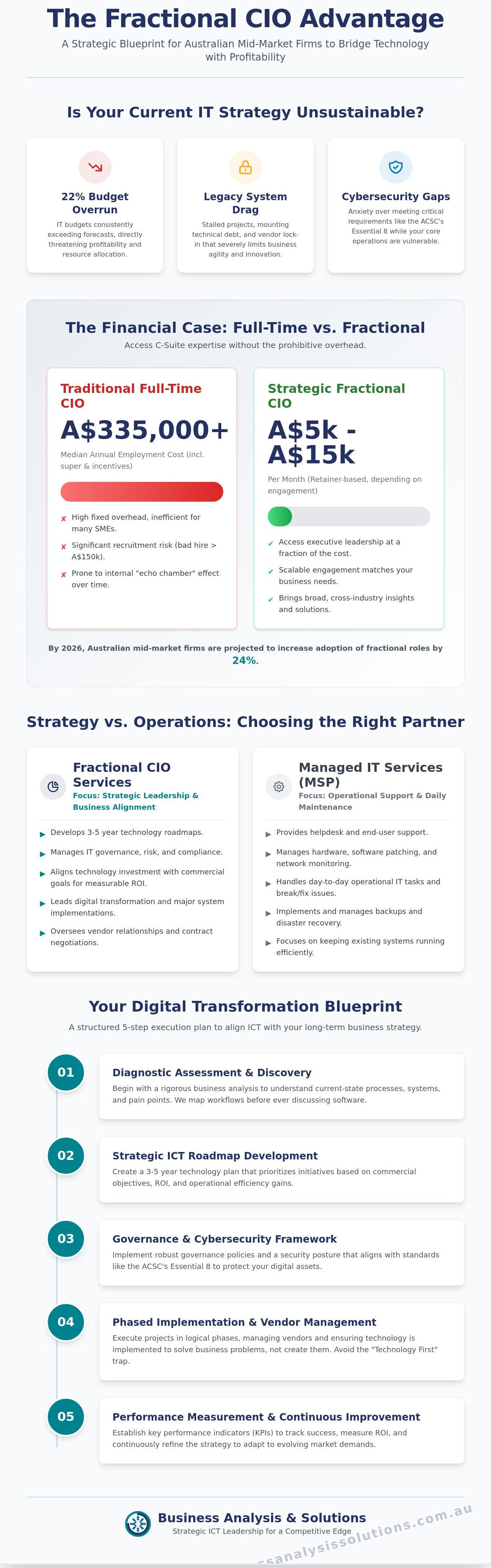
A Fractional CIO is a seasoned executive who delivers strategic technology leadership on a part-time, retainer, or project basis. Unlike a traditional consultant who might focus on a single software implementation, this individual functions as a core member of the leadership team. They take full ownership of the technology roadmap, vendor relationships, and IT governance frameworks. By 2026, Australian mid-market firms are projected to increase their adoption of these flexible roles by 24% as they move away from the rigid overhead of full-time executive contracts.
The rising demand for Fractional CIO services Australia is driven by a fundamental need for organisational agility. Companies with annual revenues between A$10 million and A$250 million often reach a plateau where their internal IT staff lacks the strategic foresight to scale operations. A Fractional CIO in Australia provides the same strategic oversight as a full-time executive but scales with the organisations specific growth phase. This ensures that digital strategy remains strictly aligned with commercial goals without the financial burden of a permanent C-suite salary.
The Evolution of Executive IT Leadership
The Australian business landscape has outgrown the traditional "Head of IT" model. Historically, this role focused on hardware maintenance and internal helpdesk support. That era has ended. Technology is now the primary driver of competitive advantage and market differentiation. The generalist approach is failing because 2026 market demands require deep expertise in specialized AI integration and sophisticated cybersecurity protocols. Businesses now require a strategic partner to design digital transformation blueprints that prioritize measurable ROI. This shift toward on-demand expertise allows firms to access high-level problem solvers who bridge the gap between complex technical requirements and board-level objectives.
Economic Benefits for Australian SMEs
Financial precision is vital for Australian small and medium enterprises (SMEs) managing tight margins. A full-time CIO in cities like Sydney, Melbourne, or Brisbane commands a median total employment cost of A$335,000. This figure includes base salary, the statutory 11.5% superannuation contribution, and performance incentives. For many growing firms, this is an inefficient allocation of capital. Fractional engagement models typically cost between A$5,000 and A$15,000 per month, depending on the required depth of engagement. This represents a significant reduction in fixed executive costs while maintaining high-level output.
Reduced Recruitment Risk: The cost of a "bad hire" at the executive level can exceed A$150,000 in direct and indirect losses. Fractional models allow for a trial period of high-level leadership without long-term contractual baggage.
Broad Industry Insight: Fractional leaders operate across multiple environments simultaneously. They bring proven Fractional CIO services Australia from different sectors, preventing the "echo chamber" effect common in long-term internal hires.
Scalable Advisory: Engagement levels are elastic. A firm can increase the CIO's hours during a major ERP rollout and decrease them once the system reaches a steady state of operation.
This methodical approach to leadership ensures that every dollar spent on IT strategy translates into tangible business value. It's a pragmatic solution for leaders who value clarity and predictable outcomes over traditional employment structures. By decoupling executive expertise from a full-time headcount, Australian businesses can invest more aggressively in the actual technologies that drive their growth.
The Foundation of Success: Why Business Analysis Precedes Technology
Many Australian organisations fall into the "Technology First" trap; they purchase expensive SaaS licenses or bespoke software before defining the internal workflows the tools are meant to serve. This backwards approach is a primary driver of project failure. Data from the 2023 Standish Group Chaos Report shows that 66% of technology projects fail to meet their original objectives, often because technical implementation began without a firm grasp of business logic. Requirements elicitation is the process of unearthing the true needs of the business before a single line of code is considered. By prioritising this analytical phase, a business ensures that its ICT investment addresses actual commercial bottlenecks rather than perceived technical gaps.
Bridging the gap between technical requirements and commercial objectives is the core responsibility of executive leadership. If a company invests A$100,000 in a new ERP system without first auditing its supply chain logic, it simply automates existing inefficiencies. Professional Fractional CIO services Australia provide the strategic distance needed to identify these risks. They focus on the "why" before the "how," ensuring every technical specification aligns with a measurable business outcome, such as a 15% reduction in operational overhead or a 20% increase in customer retention rates. This methodical approach ensures that technology serves the business strategy, not the other way around.
Process Mapping: The CIOs Secret Weapon
Effective business analysis relies on visualising the current state, or the "As-Is" process, to expose hidden inefficiencies. This step often reveals that up to 30% of administrative tasks in a typical Australian SME are redundant or manual. Once these bottlenecks are identified, the Fractional CIO designs the "To-Be" state. This future-state architecture supports scalable growth by ensuring that processes are lean and logical. Designing the To-Be state is not just about drawing diagrams; it's about building a blueprint for a company that can double its turnover without doubling its headcount. This foresight is why Fractional CIO services Australia are becoming a standard for mid-market firms looking to professionalise their IT governance. Mapping these workflows reduces the complexity of automation implementation, preventing the costly "spaghetti code" scenarios that plague poorly planned digital transformations.
Stakeholder Alignment and Digital Strategy
Technology adoption succeeds or fails based on human factors. Ensuring the Board, C-suite, and operational staff move in the same direction requires a structured approach to stakeholder engagement. A 2022 Gartner study found that 70% of digital transformations fail to reach their goals due to employee resistance and lack of leadership alignment. A Fractional CIO acts as a translator, converting "Tech-Speak" into clear business value and ROI metrics that resonate with the Board. This clarity builds the necessary trust to manage the cultural change that accompanies new ICT solutions. If you're ready to align your technology with your business goals, you can explore strategic advisory options that prioritise logic over software sales. By securing buy-in across all levels of the organisation, the transition to new systems becomes a shared objective rather than a top-down mandate.
Building this alignment often means stepping out of the formal boardroom environment. For business leaders in Brisbane fostering these crucial conversations over a coffee or lunch, you can check out The White Bird for a great local option.
Fractional CIO vs. Managed IT Services: Navigating the Australian Tech Landscape
Australian business leaders often mistake technical maintenance for strategic leadership. A Managed Service Provider (MSP) functions as the engine room; they ensure servers run, backups execute, and helpdesk tickets reach resolution. This operational focus is about "keeping the lights on." In contrast, Fractional CIO services Australia provide the navigation system. A CIO doesn't spend time fixing a broken laptop; they determine if that laptop is part of a secure, cloud-native ecosystem that reduces operational overheads by 15% over a three-year cycle. Relying on an MSP for business strategy creates a fundamental conflict of interest. An MSP's revenue often correlates with the volume of hardware or licenses they manage, which can cloud their objectivity when a business needs to lean out its infrastructure.
The gap between technical delivery and business outcomes is where most Australian SMEs lose capital. Research indicates that 64% of mid-market firms in Sydney and Melbourne struggle with technical debt because their IT decisions were made reactively rather than strategically. When you ask a technical provider to lead your digital transformation, you're asking a builder to act as an architect. The builder knows how to lay bricks, but the architect understands how the entire structure must support the owner's long-term objectives and local building codes.
Strategic Governance vs. Operational Support
The distinction between the "Architect" and the "Builder" is central to organizational maturity. A Fractional CIO maintains vendor independence, acting as a neutral party who audits the performance of your MSP. This objectivity is a financial safeguard. In June 2023, a Perth-based engineering firm engaged a Fractional CIO to audit their service contracts. By identifying redundant software subscriptions and renegotiating service level agreements to align with actual usage patterns, the firm reduced its annual IT expenditure by 22%. This resulted in a direct saving of A$94,000 in the first year alone, proving that strategic oversight pays for itself through efficiency gains.
MSP Focus: Patching, monitoring, hardware procurement, and user support.
Fractional CIO Focus: Digital roadmap, IT budget optimization, stakeholder engagement, and process mapping.
Outcome: A symbiotic relationship where the CIO directs the MSP to deliver maximum business value.
Cybersecurity and Compliance (Essential 8)
The Australian Signals Directorate (ASD) Essential 8 framework is now the non-negotiable standard for local risk management. While an MSP might deploy the technical patches required by this framework, a Fractional CIO integrates these controls into the company's broader governance and culture. They transform compliance from a defensive checkbox into a business enabler. This high-level oversight is critical for securing government contracts or passing enterprise-level due diligence during an acquisition.
While the CIO focuses on the technical and process side, building the underlying culture of trust and transparency is equally important. For specialized support in this area, you can check out Core Integrity.
Managing risk in the Pacific region requires a sophisticated understanding of data sovereignty. Under the Privacy Act 1988, Australian businesses face significant penalties for data mishandling. A Fractional CIO ensures that your data architecture prioritizes local residency to mitigate jurisdictional risks. According to 2023 reports from the OAIC, 74% of Australian consumers are more likely to trust organizations that explicitly commit to local data storage. A CIO bridges the gap between these regulatory requirements and your technical execution, ensuring your Fractional CIO services Australia investment protects both your reputation and your balance sheet.
Building Your Digital Transformation Blueprint: A 5-Step Execution Plan
Engaging Fractional CIO services Australia provides a structured framework to move from reactive troubleshooting to proactive innovation. Digital transformation fails when it lacks a logical sequence. Our 5-step execution plan ensures every A$ spent on technology delivers measurable performance gains and remains aligned with your broader commercial objectives.
Step 1: The Business Efficiency Diagnostic. We begin by identifying the highest-impact areas for improvement. This involves a 360-degree review of your current technical stack to find where technical debt or redundant processes are draining resources.
Step 2: Strategy Alignment. We ensure your ICT goals match your 3 to 5 year business plan. If your objective is to increase market share by 25% by 2027, your infrastructure must be scalable enough to handle that volume without a total rebuild.
Step 3: Requirements Elicitation. We define exactly what the business needs from new ICT solutions. This prevents the common mistake of buying software for its features rather than its ability to solve a specific operational bottleneck.
Step 4: Vendor Selection and Project Management. We execute the plan without bias. Because we don't accept commissions from software providers, our recommendations focus entirely on your firm's best interests. We manage the implementation to ensure it stays on schedule and within budget.
Step 5: Continuous Optimization. We measure ROI every 90 days and refine processes post-implementation. Technology isn't static; we ensure your systems evolve as your business grows.
The Business Efficiency Diagnostic
Expect a deep dive into your current ICT infrastructure and business processes. We analyze how data flows through your organization to identify security risks and hidden opportunities. The primary deliverable is a clear report card that outlines quick wins, such as a 15% reduction in operational overhead. You can learn more about this process by reviewing our Business Efficiency Diagnostic framework.
Automation and AI Implementation
We identify low-hanging fruit for automation to prove immediate ROI, often targeting manual data entry or repetitive reporting. A 2023 study indicated that 35% of Australian SMEs still rely on manual spreadsheets for core functions. We help you scale automation projects using the Microsoft Power Platform, ensuring all AI tools are vetted for security and business fit. This methodical approach protects your data while increasing output.
Ready to secure expert guidance for your next project? Request a consultation with our Fractional CIO team today.
Strategic ICT Leadership: Partnering with Business Analysis & Solutions
Business Analysis & Solutions leverages over 20 years of targeted Australian industry experience to resolve complex architectural and operational challenges. We recognize that mid-sized Australian enterprises often face a leadership gap where technical execution exists without strategic oversight. Our Fractional CIO services Australia fill this void by providing high-level governance without the A$280,000 plus annual salary commitment of a full-time executive. This model allows you to access elite expertise on a schedule that fits your current operational requirements.
We offer a "Boutique Advantage" that larger global consultancies can't replicate. You engage directly with senior consultants who possess a minimum of 15 years of individual field experience. You won't be handed off to a junior account manager once the contract is signed. This direct access ensures that every strategic recommendation is grounded in practical reality and technical feasibility. We focus on business agency; our goal is to empower your internal teams to maintain progress long after a specific project concludes. It's about building your internal capacity, not creating a cycle of dependency.
Integrating a new executive presence shouldn't disrupt your existing workflow. Our consultants operate as an extension of your current team, aligning with internal cultures while providing the external perspective necessary for growth. Data from 2023 indicates that 65% of IT projects fail due to poor communication between departments. We mitigate this risk by acting as the translator between the server room and the boardroom. This ensures that every A$1 spent on technology generates a measurable return on investment through logical system alignment and reduced technical debt.
The Business Analysis & Solutions Methodology
Our approach is methodical, objective, and deeply committed to problem-solving. We utilize a structured framework to bridge the gap between technical requirements and overarching business objectives. By focusing on stakeholder engagement and rigorous requirements elicitation, we eliminate the ambiguity that often stalls IT initiatives. We adopt a direct, no-nonsense Australian communication style. This removes unnecessary jargon and focuses on delivering a 20% to 35% improvement in process efficiency. We don't just provide advice; we deliver a roadmap for tangible performance that prioritizes clarity over complexity.
Next Steps: Securing Your Organizations Future
Transitioning from a reactive IT posture to proactive digital leadership requires a calculated shift in strategy. Many organizations we audit are spending 75% of their IT budget on basic maintenance rather than innovation. An initial consultation allows us to identify these strategic gaps immediately. We examine your current architecture to find redundancies that could save your organization thousands in monthly licensing fees. Secure your competitive edge by aligning your technology stack with your growth targets for 2025 and beyond.
Ready to stabilize your infrastructure and drive meaningful digital change? Book a Fractional CIO Consultation to begin the transition toward a more resilient, scalable digital infrastructure. Our Fractional CIO services Australia provide the steady hand and analytical precision required to navigate the complexities of modern business technology.
Positioning Your Organisation for 2026 Strategic Growth
Modern Australian enterprises can't afford to treat technology as a secondary operational cost. Success in the 2026 landscape requires a deliberate shift from basic managed services to high-level strategic ICT leadership. By prioritising business efficiency diagnostics before technical implementation, leaders ensure that every A$ spent on digital transformation delivers a measurable return on investment. Our methodology focuses on eliminating the ambiguity that often plagues complex technical projects.
Business Analysis & Solutions brings over 20 years of industry experience to help you navigate rigorous Australian compliance standards, including the ASD Essential 8 framework. We specialise in bridging the gap between technical requirements and commercial objectives through our Fractional CIO services Australia. We've refined a structured, 5-step execution plan that removes the guesswork from ICT governance and secures your digital infrastructure against evolving threats. It's time to replace reactive fixes with a methodical, data-driven approach to technology management.
Book your Fractional CIO Consultation with our expert Perth team at businessanalysissolutions.com.au to start optimising your operations today. Your path to a more efficient, compliant, and resilient business starts with a single strategic conversation. We look forward to untangling your organizational complexities together.
Frequently Asked Questions
What is the difference between a vCIO and a Fractional CIO?
A Fractional CIO provides strategic executive leadership and business alignment as a member of your senior management team. In contrast, a vCIO is typically a service offered by a Managed Service Provider (MSP) that focuses on technical roadmaps and infrastructure maintenance. The Fractional CIO prioritizes long term commercial objectives and stakeholder engagement, ensuring technology drives revenue rather than just maintaining operational stability.
How much do Fractional CIO services cost in Australia?
Fractional CIO services Australia typically cost between A$3,000 and A$10,000 per month depending on the engagement scope. This structure represents a 70% saving compared to the A$250,000 average annual salary of a full time executive in Sydney or Melbourne. Most firms offer fixed monthly retainers or day rates starting at A$1,500, which allows for predictable budgeting without the overhead of permanent headcount.
Does my business need a Fractional CIO if we already have an IT Manager?
You need a Fractional CIO if your IT Manager focuses on daily tactical operations rather than high level strategy. An IT Manager handles infrastructure and user support, while a CIO aligns technology investments with your 3 year business plan. Data from 2023 indicates that companies employing both roles see a 25% improvement in project delivery speeds because the CIO bridges the gap between technical teams and the board.
Can a Fractional CIO help with cybersecurity compliance like the Essential 8?
A Fractional CIO directly manages the implementation of the ACSC Essential 8 framework to mitigate organizational risk. They translate technical vulnerabilities into clear business risk assessments for executive review. By 2025, 60% of Australian mid market firms will require formal compliance to secure cyber insurance or government contracts. Your CIO ensures technical controls meet these specific regulatory standards through rigorous process mapping and regular audits.
How many hours a month does a Fractional CIO typically work?
Most engagements range from 8 to 40 hours per month based on your organizational complexity. A standard 16 hour monthly commitment often includes two days of on site strategy sessions and remote stakeholder engagement. This flexible model allows you to scale executive oversight during major transitions, such as an ERP implementation. We adjust the cadence as your technical requirements and strategic priorities evolve over the fiscal year.
What industries benefit most from Fractional CIO services?
Professional services, manufacturing, and healthcare sectors gain the most from Fractional CIO services Australia. These industries face high regulatory pressure and complex data requirements that demand expert oversight. Australian manufacturing firms currently investing in Industry 4.0 technologies require strategic guidance to integrate legacy systems with new digital assets. Any organization with 50 to 500 employees typically finds the highest return on these specialized leadership services.
Will a Fractional CIO replace our existing IT support company?
A Fractional CIO doesn't replace your Managed Service Provider (MSP) or internal support desk. They act as an objective advisor who holds these vendors accountable to Service Level Agreements (SLAs). They ensure your support partner's roadmap aligns with your specific business objectives. By managing this relationship, the CIO removes the burden of technical vendor management from the CEO or CFO, allowing them to focus on core operations.
How do you measure the ROI of a Fractional CIO engagement?
We measure ROI through tangible metrics like a 15% reduction in annual technology spend and improved system uptime. A successful engagement often identifies redundant software licenses that save companies A$20,000 or more within the first 90 days. We also track the successful mitigation of high priority risks identified in initial audits. These results provide a clear financial justification for the investment in strategic leadership and process optimization.



Comments