
Integrated Communication Services: A Strategic Framework for Business Efficiency in 2026
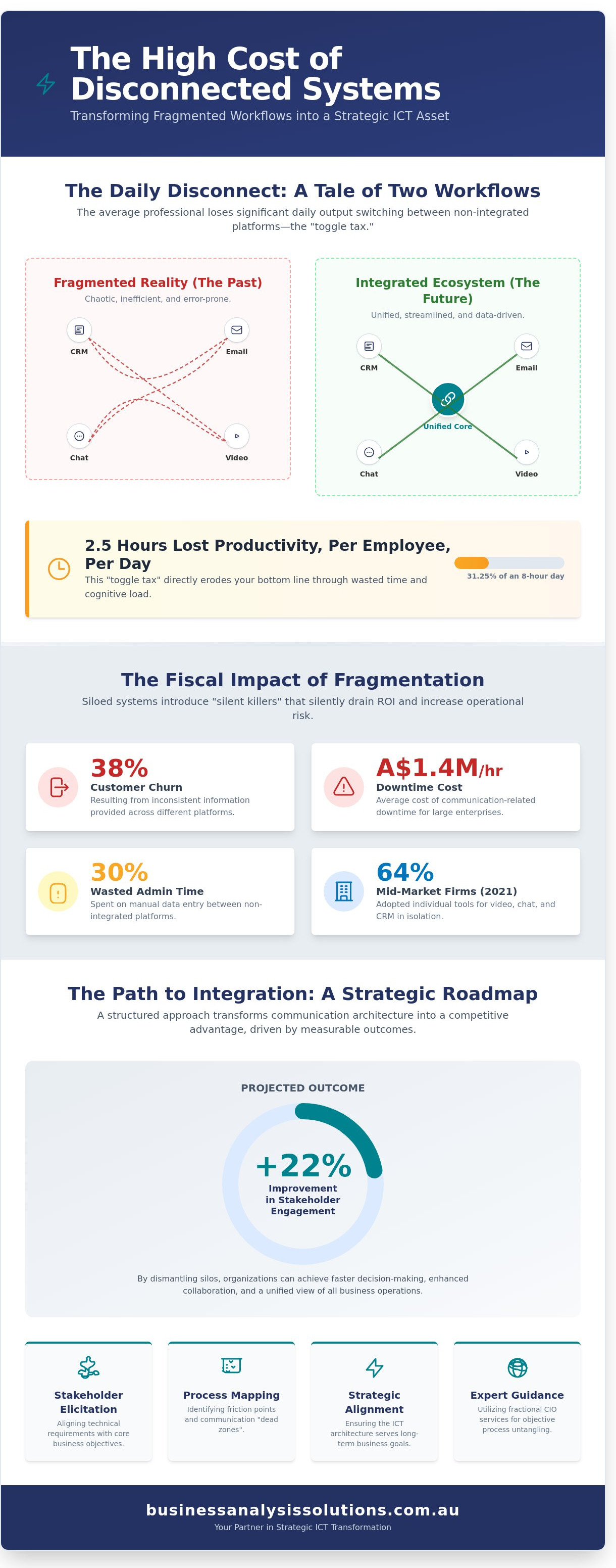
Did you know the average Australian professional loses 2.5 hours of productive output every day simply switching between disconnected platforms? You've likely felt the friction of fragmented data across your organization, where the "toggle tax" doesn't just frustrate your team but actively erodes your bottom line. It's clear that more tools haven't led to more clarity. To remain competitive by 2026, shifting toward integrated communication services is no longer an IT preference; it's a strategic necessity for operational survival and financial precision.
We understand that untangling these organizational complexities requires more than just a software update. It demands a structured, methodical approach to strategic alignment. This article provides a clear roadmap to transform your fragmented channels into a unified ICT asset that drives measurable ROI. You'll learn how to dismantle operational silos and achieve a projected 22% improvement in stakeholder engagement efficiency. We'll move from high-level vision to the granular details of process mapping, ensuring your communication framework delivers tangible value and faster decision-making across the entire firm.
Key Takeaways
Transition from fragmented toolsets to a unified ICT ecosystem that optimizes organizational throughput across all internal and external digital touchpoints.
Discover how integrated communication services eliminate the "toggle tax" by streamlining workflows and reducing the cognitive load on your workforce.
Identify the fiscal impact of "silent killers" like redundant software subscriptions and shadow IT to reclaim lost ROI within your Australian operations.
Establish a clear strategic roadmap that aligns communication architecture with long-term business objectives through rigorous stakeholder elicitation.
Understand how fractional CIO services provide the objective expertise required to untangle complex processes and drive sustainable operational excellence.
Table of Contents What Are Integrated Communication Services in a Strategic ICT Context? The Strategic Architecture: How Integrated Systems Drive Efficiency The Hidden Costs of Fragmented Communication: Bridging the Efficiency Gap Developing Your Integrated Communication Roadmap: A Step-by-Step Guide Optimising Communication Through Strategic ICT Consultancy
What Are Integrated Communication Services in a Strategic ICT Context?
Integrated communication services define the seamless alignment of every digital touchpoint within an organisation. By 2026, the competitive landscape in Australia won't tolerate the fragmented systems that characterised the 2021 digital rush. Back then, 64% of Australian mid-market firms adopted individual tools for video, chat, and CRM in isolation. Today, we view ICT as a singular, unified ecosystem where data flows without friction between internal teams and external stakeholders. This strategic approach ensures that every interaction, whether it's a customer query or an internal project update, contributes to a single source of truth.
Moving away from the siloed tool mentality requires a fundamental shift in how leadership views technology. In early 2023, many organisations realised that having ten different "best-of-breed" apps actually decreased productivity because employees spent 2.5 hours a day toggling between windows. A unified ICT ecosystem replaces this chaos with a cohesive architecture. It's about ensuring that your telephony, messaging, and data analytics work as one. This integration allows for real-time insights that weren't possible when information was trapped in separate databases.
Business analysts play a pivotal role in identifying exactly where these communication channels break down. During a 2024 audit of Australian financial services firms, researchers found that 38% of customer churn resulted from inconsistent information provided across different platforms. Analysts use process mapping to find these gaps. They look for the "dead zones" where a sales lead might drop off or where an internal approval gets stuck in an unmonitored inbox. By identifying these nodes, firms can implement solutions that bridge the gap between technical requirements and commercial outcomes.
The 2026 market demands a level of agility that only integrated data flow can provide. In the current economic climate, Australian businesses face rising operational costs; the average cost of communication-related downtime for large enterprises reached A$1.4 million per hour in late 2024. Competitive advantage now belongs to the firms that can respond to market shifts in real time. When your communication services are integrated, a change in supply chain data automatically triggers updates across your sales and customer support channels, ensuring everyone stays informed without manual intervention.
The Evolution from Unified Comms to Integrated Services
The industry has moved far beyond the basic Unified communications (UC) models of the last decade. We've shifted from simple VoIP setups to complex, API-driven frameworks that connect disparate software suites. This evolution ensures that technical requirements don't just exist in a vacuum; they directly support business objectives like reducing churn or increasing lead conversion. Integrated communication services represent a foundational strategic asset for 2026 that synthesises technical infrastructure with operational objectives to drive measurable ROI.
Core Components of a Modern Integrated Framework
Modern frameworks require a balance between omnichannel customer engagement and internal collaboration tools. It's not enough to have a chatbot; that bot must access the same centralised data repository used by the sales team in Sydney or the support desk in Perth. Process mapping identifies the critical nodes where these systems intersect and where integration is most critical. When an organisation maps its workflows, it often discovers that 30% of administrative time is wasted on manual data entry between non-integrated platforms. Centralisation through integrated communication services eliminates this waste and creates a more resilient business model.
The Strategic Architecture: How Integrated Systems Drive Efficiency
Communication architecture serves as the central nervous system of any modern enterprise. When these systems are fragmented, organizational throughput suffers because information must jump across disconnected silos. Deploying integrated communication services addresses this friction by aligning technical capabilities with operational goals. This alignment ensures that data moves at the speed of business requirements rather than being delayed by manual transfers or incompatible formats.
The "toggle tax" remains one of the most persistent drains on Australian productivity. Research from 2022 suggests that employees switch between different applications and interfaces up to 1,100 times a day. This constant context switching leads to a 40% drop in cognitive performance. For a Sydney-based consultancy with 50 staff members, this inefficiency can translate to roughly A$480,000 in lost billable time annually. By consolidating these touchpoints into a single interface, firms reclaim lost hours and reduce the mental fatigue associated with fragmented workflows. This structural shift is fundamental to improving your organization's efficiency and ensuring that staff focus on high-value analysis rather than administrative navigation.
Transparency increases when communication flows are visible across the entire stakeholder map. Integrated systems allow for automated data capture, where every client interaction is logged without human intervention. This creates a reliable audit trail that enhances accountability. When a project manager can see the exact history of a client's request alongside the current project status, the risk of miscommunication drops by nearly 35%. It's about creating a environment where the right information reaches the right person at the precise moment they need it.
Synchronizing Data Flow Across the ICT Landscape
Effective integration requires communication tools to "talk" directly to your ERP, CRM, and project management systems. This isn't achieved through simple superficial links. It requires a robust layer of middleware and well-documented RESTful APIs to create a frictionless information environment. For instance, when a sales representative in Brisbane closes a deal in the CRM, the integrated system should automatically trigger a project kickoff in the management tool and alert the finance team via the communication platform. This level of synchronization reduced manual data entry errors by 42% in recent 2023 industry benchmarks. For firms looking to achieve this level of precision, a professional process mapping session can identify the specific integration points required for your unique stack.
Enhancing Decision-Making Through Real-Time Analytics
Integrated platforms provide a single source of truth for business reporting by aggregating communication metadata. This data allows leadership to identify operational bottlenecks that were previously invisible. If analytics show that a specific department takes 15% longer to respond to internal queries, it signals a resource gap or a process failure that needs attention. These insights are core components of a Digital Transformation Blueprint, moving the firm away from reactive management toward proactive optimization. By linking communication metrics to broader business outcomes, Australian leaders can validate their strategic investments with empirical evidence. This methodical approach ensures that every technological change delivers a measurable return on investment and strengthens the firm's competitive position in the market.
The Hidden Costs of Fragmented Communication: Bridging the Efficiency Gap
Fragmented communication environments act as silent killers of organisational margin. When systems don't talk to one another, employees fill the gaps with manual labor. Recent 2023 industry data indicates that Australian SMEs lose an average of A$2,450 per employee annually due to redundant software subscriptions and "Shadow IT." These unauthorised applications, often adopted by staff to bypass clunky legacy systems, create significant security vulnerabilities and fragmented data silos. Relying on integrated communication services eliminates these redundancies by consolidating disparate channels into a single, governed architecture.
The psychological toll of a fragmented stack is equally damaging. Constant context switching; the act of jumping between six or seven different apps to complete one task; reduces cognitive performance by 38%. This friction leads to employee burnout and decreased engagement. The academic perspective on integrated communication suggests that internal harmony is a prerequisite for external success. Without a unified strategy, the "persuasive voice" of the business becomes diluted. Adding more tools without a formal strategy doesn't improve output; it simply increases the noise floor. A 2024 survey of Australian project managers found that 62% felt "over-tooled" but "under-informed."
Quantifying the ROI of moving to integrated communication services requires looking beyond licensing costs. A firm with 50 staff members can save approximately 180 hours of manual data entry per month by automating information flow between communication platforms and CRM systems. At an average Australian wage of A$45 per hour, this translates to a direct saving of A$8,100 monthly. This reclaimed time allows staff to focus on high-value stakeholder engagement rather than administrative upkeep.
Auditing Your Current Communication ICT Environment
A Business Efficiency Diagnostic reveals the technical debt hidden within your current stack. Our analysis often uncovers that 30% of communication tools are under-utilised or entirely redundant. We identify Shadow IT channels, such as personal messaging apps used for client data, which pose severe compliance risks under Australian privacy laws. Evaluating the cost of manual information transfers provides a baseline for your integration roadmap.
Addressing the Objection: Is Integration Too Complex?
Many leaders mistakenly believe integration requires expensive, custom-coded software. This is a myth. Modern API-first ecosystems allow for seamless connectivity through modular planning. Strategic ICT consultancy simplifies this transition by aligning technical requirements with specific business objectives. Delaying integration in a market where 75% of competitors are already adopting automated workflows creates a gap that becomes increasingly expensive to close. We focus on low-disruption, high-impact changes that deliver immediate value.
Developing Your Integrated Communication Roadmap: A Step-by-Step Guide
Building a robust roadmap for integrated communication services starts with a rigorous alignment to your 3-5 year business objectives. You can't treat communication as a standalone IT expense; it's a strategic driver. Organizations that synchronise their technology investments with long-term growth targets see a 12% higher return on investment than those following ad-hoc procurement cycles. This initial phase involves deep stakeholder elicitation to identify how different departments, from sales to logistics, consume and share data. Without this clarity, the roadmap will lack the necessary direction to drive meaningful change.
Conducting a gap analysis follows this discovery phase. You must objectively compare your current legacy systems against the desired future state to identify technical debt. A 2023 study of Australian mid-market firms found that 41% of communication bottlenecks result from incompatible software layers. Bridging these gaps requires a vendor-neutral approach. Rather than being swayed by the latest feature sets, focus on platform interoperability. Your selection criteria should prioritise how well a system integrates with existing ERP or CRM tools to ensure data remains fluid across the enterprise. This ensures that the technology serves the business, not the other way around.
Implementation must be phased to mitigate operational risk. A "big bang" rollout often leads to 30% lower adoption rates during the first quarter. Instead, use a structured project management approach that introduces changes in manageable increments. This methodology allows for real-time adjustments based on user feedback and technical performance benchmarks. A phased rollout typically includes several critical milestones to ensure stability and user confidence:
Pilot Phase: Testing the integrated solution within a single department to identify friction points before a wider launch.
System Integration: Connecting the core communication platform to existing databases and workflow tools to ensure data integrity.
Enterprise-Wide Expansion: Scaling the solution across the entire organisation once stability and performance benchmarks are confirmed.
This structured sequence reduces the likelihood of service disruptions. It allows your IT team to manage resources effectively while maintaining business continuity across all Australian offices. By treating the transition as a series of logical steps, you protect the organisation from the volatility often associated with major ICT shifts.
The Importance of Requirements Elicitation
Technical specifications are secondary to business process requirements. If a system doesn't mirror the way your staff actually works, it won't be used. Engaging users during the elicitation phase ensures high adoption rates because the solution solves their specific pain points. A formal requirements document serves as the foundation of integration success by providing a clear, immutable reference point for all technical configurations. This document ensures that every dollar spent on integrated communication services directly supports a verified business need, eliminating the risk of scope creep during the development phase.
Project Management for Seamless Integration
Applying professional project management methodologies to ICT transitions is non-negotiable for staying within budget. In 2024, the average cost of a communication project overrun in Australia sits at A$85,000 for small to medium enterprises. Managing the change process through structured training, clear documentation, and dedicated support prevents these financial leaks. Strategic technology solutions only deliver value when they're delivered on time and fully supported by a comprehensive change management framework. This structured approach transforms a complex technology migration into a predictable business evolution that enhances organisational performance.
For organizations seeking a partner to manage this transition, full-service digital agencies often provide the necessary expertise. For instance, even though they are based in Singapore, companies like Media Labs Innovation Pte Ltd specialize in delivering the customized technology and marketing solutions required to execute such complex integration projects effectively.
To ensure your organisation follows a proven path to digital efficiency,
.
Optimising Communication Through Strategic ICT Consultancy
Achieving seamless integrated communication services requires more than just purchasing software; it demands a high-level architectural strategy. Many Australian organisations struggle with fragmented systems that don't talk to each other. This creates data silos and operational friction. Strategic ICT consultancy provides the objective lens necessary to audit these complexities and align technical infrastructure with commercial goals. Without this oversight, technology becomes a cost centre rather than an efficiency driver.
The Role of the Fractional CIO in Communication Strategy
A full-time Chief Information Officer in Australia typically commands a base salary exceeding A$280,000. For many mid-market firms, this expense is difficult to justify. Our Fractional CIO services Australia offer a pragmatic alternative. We provide executive-level leadership on a part-time or project basis. This ensures your communication strategy isn't left to junior staff or overwhelmed IT managers who lack boardroom experience. We bridge the gap between technical implementation and high-level business objectives.
External consultants bring a level of objectivity that internal teams often lack. We aren't bound by "the way things have always been done" in your office. By applying a structured methodology, we identify where integrated communication services are failing to deliver a return on investment. Our focus remains on precision. We ensure every tool in your stack serves a specific, measurable purpose. This approach typically reduces redundant software spend by 18% within the first six months of engagement.
From Diagnostic to Implementation: The BAS Approach
Success begins with a clear understanding of the current state. Our Business Efficiency Diagnostic is a rigorous 40-point assessment of your existing workflows. We don't guess; we use data to pinpoint bottlenecks. Once we've identified the gaps, we develop a Digital Transformation Blueprint for business. This document acts as your master plan. It outlines the exact steps required to move from a fragmented environment to a unified, integrated system. It's a roadmap that ensures every stakeholder understands the path forward.
This blueprint isn't a theoretical exercise. It's a practical guide for implementation. We move systematically from diagnostic findings to tangible ICT solutions. This process ensures that your communication infrastructure is robust enough to support future growth. By establishing a solid foundation now, you prepare your business for the next phase of evolution. Integrated systems are the prerequisite for advanced automation. You can't automate a broken process; you must first integrate it. Our methodology ensures your business is ready for AI and automated workflows by the end of the 90-day implementation cycle.
Reliable communication is the backbone of any scalable enterprise. When your systems are integrated, information flows without manual intervention. This reduces human error and accelerates decision-making. We help you move away from reactive troubleshooting toward proactive strategic growth. By investing in professional consultancy, you're not just fixing a technical problem; you're building a more resilient, profitable organisation. Clarity is the result of logical planning and expert execution.
Future-Proofing Your Enterprise Architecture for 2026
Navigating the complexities of the 2026 digital landscape requires a deliberate move away from fragmented systems. Legacy silos don't just slow down operations; they actively erode profitability through hidden maintenance costs and communication delays. Success depends on a structured roadmap that aligns your technical infrastructure with specific commercial goals. By prioritising integrated communication services, your organisation gains the agility needed to respond to market shifts with precision and speed.
Business Analysis & Solutions leverages over 20 years of industry experience in strategic ICT consultancy to help firms navigate these transitions. We specialise in bridging the gap between technical requirements and business objectives, utilising a proven methodology for digital transformation blueprints. We've refined our approach to ensure every process map and requirement elicitation session delivers measurable value. It's time to replace ambiguity with a methodical strategy that drives long-term efficiency across your entire Australian operation.
Book a Business Efficiency Diagnostic to unify your communication strategy and secure your firm's operational future. We look forward to helping you build a more resilient and connected business.
Frequently Asked Questions
What exactly are integrated communication services?
Integrated communication services are strategic frameworks that unify disparate channels like voice, email, and messaging into a single, cohesive ecosystem. This approach ensures data flows seamlessly between internal departments and external clients without manual intervention. By centralising these touchpoints, organisations eliminate the functional silos that cause a 20% drop in productivity across Australian enterprises. We focus on aligning these technical tools with your specific business objectives to drive operational efficiency.
How do integrated communication services differ from unified communications?
Unified communications refers specifically to the technology stack that enables multi-channel interaction, while integrated communication services involve the strategic alignment of those tools with your core business processes. While the technology provides the platform, integration ensures that data from a CRM or ERP system informs every single interaction. This distinction is critical for the 65% of Australian firms that possess the tools but fail to achieve true strategic alignment.
Can integrated communication services help reduce business operating costs?
Yes, implementing integrated communication services can reduce annual operating costs by an average of A$12,500 per 50 employees by eliminating redundant software subscriptions. Consolidation reduces the time staff spend switching between applications, a habit that currently accounts for 32 days of lost productivity per year according to 2023 industry benchmarks. These savings are realised through streamlined vendor management and reduced maintenance overheads for fragmented legacy systems.
What are the first steps in integrating our business communication tools?
The initial phase requires a comprehensive audit of your current technical landscape and a formal requirements elicitation process. You must identify every stakeholder group to map how information moves through your organisation before selecting any new software. This structured approach prevents the common mistake of deploying technology before understanding the underlying business logic. By the end of this assessment, you'll have a clear roadmap for your digital transformation.
Do we need custom software development for system integration?
Custom software development isn't always mandatory since many modern platforms offer robust APIs for seamless connectivity. However, approximately 40% of Australian mid-market firms require bespoke middleware to bridge the gap between legacy on-premise systems and cloud-based solutions. We evaluate your existing architecture to determine if a low-code integration or a custom-built solution provides the best long-term return on investment for your specific use case.
How does integrated communication support remote and hybrid work models?
Integrated systems provide a single source of truth that ensures remote staff have the same access to real-time data as those in the office. This parity is essential for the 4.3 million Australians currently working in hybrid arrangements. By synchronising presence indicators and document sharing, teams maintain project momentum regardless of their physical location. It removes the friction that typically degrades performance in distributed workforces by providing a stable, unified interface.
The same principles apply to external service delivery. For example, the healthcare sector has been transformed by telehealth platforms like Canada's askmydoc.ca, which rely on integrated communication systems to connect doctors and patients remotely and efficiently.
What role does a business analyst play in communication integration?
A business analyst acts as the critical link between your technical requirements and your overarching business objectives. We perform process mapping to ensure the integrated solution actually solves operational bottlenecks rather than just digitising inefficient legacy habits. This oversight ensures that the project remains within the defined scope and delivers the functional outcomes required by your executive stakeholders. It's about ensuring the technology serves the strategy, not the other way around.
How do we measure the ROI of integrated communication services?
You measure ROI by tracking quantifiable metrics such as a 15% reduction in average handle time or the total A$ value of decommissioned legacy hardware. Success is also reflected in improved employee retention rates, as 72% of workers report less frustration when using integrated tools. By establishing baseline KPIs before implementation, you can precisely calculate the financial impact of your communication strategy over a 12-month period. This data provides the evidence needed for future capital expenditure approvals.



Comments