
Strategic ICT Solutions: A Guide to Business Alignment and Efficiency in 2026
Updated: Apr 8
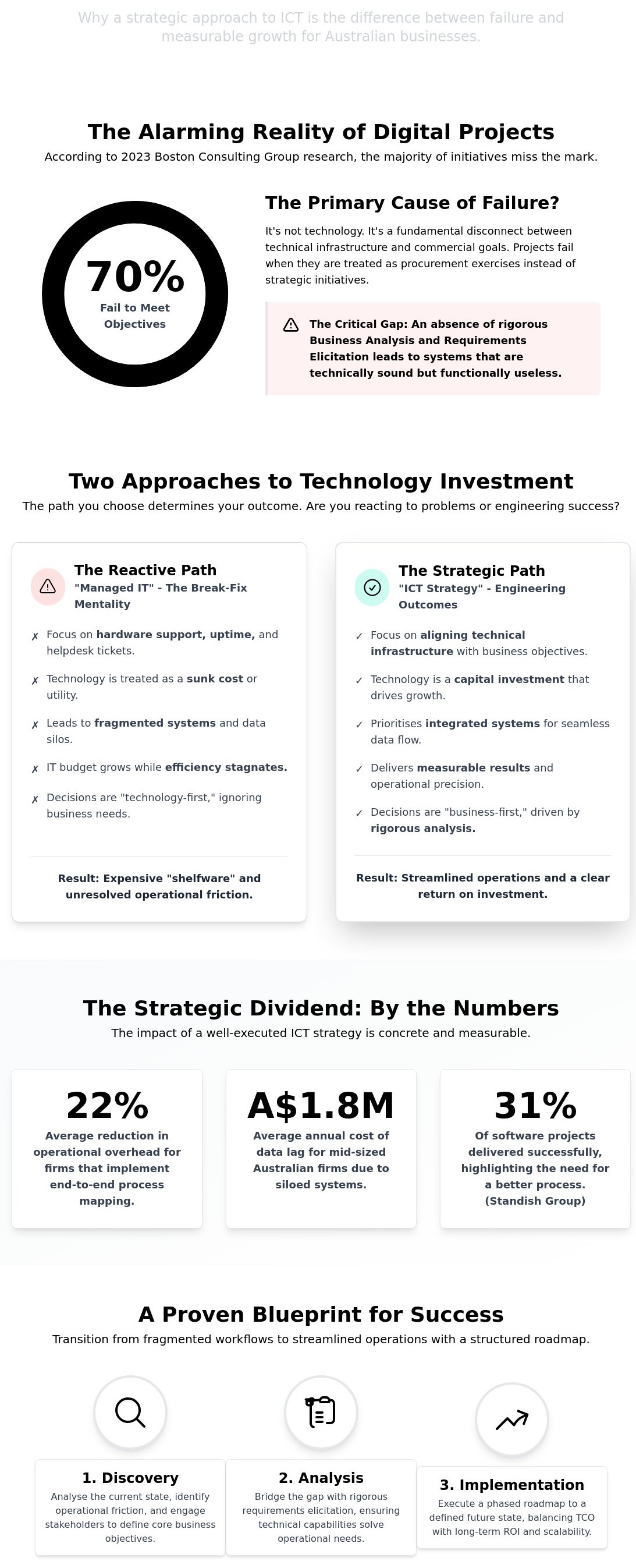
Why do 70% of digital transformations fail to meet their objectives according to 2023 Boston Consulting Group research? In the Australian business sector, the disconnect between technical infrastructure and commercial goals often stems from treating ict solutions as isolated tools rather than strategic assets. You’ve likely seen the symptoms: fragmented systems that refuse to talk to each other and an IT budget that grows while visible efficiency remains stagnant. It’s a logical frustration when technical complexity outpaces actual business value.
You understand that technology should be an accelerator, not a bottleneck. This guide provides the framework to bridge that gap through expert ICT strategy and rigorous business analysis. We’ll outline a clear digital transformation roadmap for 2026 that replaces fragmented workflows with automated, streamlined operations. You’ll discover how to transition from reactive troubleshooting to proactive, strategic alignment that ensures every A$1 spent on your infrastructure drives measurable growth and operational precision.
Key Takeaways
Transition from reactive hardware support to a proactive digital strategy that aligns technical infrastructure with core business objectives.
Mitigate the risk of project failure by prioritising requirements elicitation to bridge the gap between technical capabilities and operational needs.
Develop a robust framework for evaluating ict solutions that balances Total Cost of Ownership (TCO) with long-term ROI and scalability for the Australian market.
Execute a structured digital transformation roadmap, moving methodically from discovery and current-state analysis to a defined future-state vision.
Leverage Fractional CIO services to gain executive-level strategic oversight and technical leadership without the overhead of a full-time hire.
Table of Contents What are ICT Solutions in 2026? Defining the Strategic Landscape The Critical Gap: Why ICT Projects Fail Without Business Analysis Evaluating ICT Solutions: A Framework for Strategic Alignment The Digital Transformation Blueprint: A Roadmap to Implementation Navigating Complexity with Fractional CIO and Expert Consultancy
What are ICT Solutions in 2026? Defining the Strategic Landscape
By 2026, the definition of Information and communications technology (ICT) has moved far beyond the traditional boundaries of hardware and software. It now represents the complete integration of telecommunications, enterprise computing, and data management systems. For Australian businesses, this evolution is critical. Recent data suggests that Australian enterprises will invest over A$135 billion in digital transformation during the 2026 financial year. This investment signals a shift from treating technology as a utility to viewing it as a core driver of strategic alignment.
Modern ict solutions are no longer reactive. The era of the "break-fix" mentality, where IT was only summoned when a server failed, ended years ago. In 2026, high-performing organisations use proactive digital strategies to eliminate operational friction. They prioritise integrated systems over standalone software silos. A siloed approach, where a CRM operates independently of financial reporting tools, creates data lag. This lag costs mid-sized Australian firms an average of A$1.8 million annually in lost productivity and missed market opportunities. Strategic ICT management replaces these gaps with seamless data flows that support rapid decision-making.
Efficiency is the primary metric for success. When ict solutions are correctly managed, they deliver measurable results. We see this through a 22% average reduction in operational overhead for firms that successfully implement end-to-end process mapping. These organisations don't just buy tools; they engineer outcomes. They ensure that every technical requirement serves a specific business objective, creating a direct link between digital infrastructure and the bottom line.
The Components of a Modern ICT Ecosystem
A contemporary ecosystem relies on cloud infrastructure that supports the 74% of Australian professionals now working in hybrid environments. It's not just about remote access; it's about secure, low-latency collaboration. Integrated communication services must link directly with data-driven platforms like Power BI. This allows stakeholders to access real-time visualisations of project health and financial performance. Without this integration, data remains trapped in spreadsheets, losing its value within 24 hours of collection.
ICT vs. Managed IT: Understanding the Difference
Fixing a computer is a technical task; optimising a business is a strategic one. Managed IT services typically focus on helpdesk support, uptime, and hardware maintenance. While essential, this model doesn't drive growth. ICT strategy, however, involves deep consultancy, requirements elicitation, and stakeholder engagement. It focuses on how technology can redefine a business model rather than just keeping the lights on. You can determine your current reliance by reviewing your last three major tech investments. If those investments were purely for hardware replacement rather than process improvement, your business is likely stuck in a reactive IT cycle. Transitioning to a strategic model requires a partner who understands Australian market regulations and international performance standards. This shift ensures that your technology spend acts as a capital investment rather than a recurring sunk cost.
The Critical Gap: Why ICT Projects Fail Without Business Analysis
The Standish Group's 2020 Chaos Report reveals a sobering reality for executive leadership: only 31% of software projects are delivered successfully. The primary driver of the remaining 69% of failures isn't a lack of coding skill or hardware capacity. It's the absence of rigorous requirements elicitation. When organisations prioritize "technology-first" thinking, they treat digital transformation as a simple procurement exercise. This mindset leads to the acquisition of tools that don't solve the underlying operational friction, resulting in expensive shelfware and frustrated teams.
The danger of this approach is most evident when Evaluating ICT Solutions without a clear business case. Technical teams often focus on feature sets and "out-of-the-box" capabilities, while business stakeholders focus on high-level outcomes. Without a structured analysis framework, these two groups speak different languages. This communication gap creates a vacuum where assumptions replace facts, leading to systems that are technically sound but functionally useless for the end-user.
The Power of Process Mapping
Process mapping is the architectural drawing of business logic. It provides a visual representation of how work actually flows through an organisation, rather than how management thinks it flows. By documenting every touchpoint and decision gate, we identify bottlenecks before any automation occurs. In the Australian mid-market, we've observed firms lose upwards of A$150,000 in wasted implementation hours because they attempted to automate a broken or redundant process.
Effective ict solutions must support existing organisational strengths rather than forcing rigid, arbitrary changes on the workforce. When you map a process, you're looking for opportunities to simplify. If a process requires 12 steps and four manual approvals, digitising that exact workflow just makes the inefficiency faster. A logical, methodical analysis allows for process optimisation first, ensuring that the technology serves the strategy, not the other way around.
Stakeholder Engagement and Requirements Elicitation
Successful project delivery relies on gathering input from every level of the hierarchy. Frontline staff often possess the most granular knowledge of operational pain points, yet they're frequently excluded from the planning phase. Requirements elicitation is the formal process of turning these vague, anecdotal needs into precise technical specifications. It's the difference between a user saying "I need better reports" and a requirement stating "The system must generate a real-time AUD cash-flow summary by 5:00 PM every Friday."
Reducing Scope Creep: Clear initial diagnostics can reduce project scope creep by as much as 40%, keeping budgets under control.
Strategic Alignment: Ensuring every technical feature maps directly back to a specific business objective or KPI.
Risk Mitigation: Identifying regulatory or compliance hurdles, such as Australian Privacy Principles, early in the design phase.
Without this level of detail, projects inevitably drift. Costs spiral as new requirements are discovered mid-build, and the original timeline becomes impossible to meet. If your current digital strategy feels disconnected from your daily operations, a professional requirements diagnostic can provide the structural clarity needed to realign your investments with your actual business needs. Precision at the start of a project is the only way to ensure value at the end.
Evaluating ICT Solutions: A Framework for Strategic Alignment
Strategic alignment ensures that every dollar spent on ict solutions translates into measurable performance gains. Selection is not merely a technical procurement task; it is a high-stakes financial decision. Evaluation must move beyond the initial license fee. A comprehensive Total Cost of Ownership (TCO) model includes implementation, staff training, and a 15% annual contingency for ongoing maintenance. If an ict solutions provider quotes A$100,000 for a rollout, the three-year operational cost often exceeds A$165,000. This discrepancy is where many projects fail to deliver the expected Return on Investment (ROI).
Scalability is the next critical pillar. Australian businesses often face a "growth ceiling" where legacy systems fail once the workforce exceeds 50 employees or transaction volumes spike. A scalable solution requires cloud-native architecture that can handle a 300% increase in data throughput without requiring a full infrastructure rebuild. This future-proofing prevents the costly cycle of replacing software every three years. To see how these principles are applied in other markets with enterprise-level cloud solutions, you can visit BridgeWellTek.
Security and compliance are non-negotiable in the current regulatory environment. Adhering to the Australian Signals Directorate’s (ASD) Essential 8 framework is the benchmark for local resilience. Effective solutions must integrate these standards by default, particularly regarding multi-factor authentication and regular patching. Statistics from 2023 indicate that firms strictly following the Essential 8 reduce their risk of a successful cyber breach by approximately 85%.
Finally, integration capabilities determine the long-term viability of the stack. Modern systems must communicate seamlessly with existing ERP or CRM platforms like SAP, Microsoft Dynamics, or Salesforce. Without robust API connectivity, data silos form. These silos force staff into manual workarounds, which increases the likelihood of human error by 25% and slows down decision-making cycles.
The Business Efficiency Diagnostic
Conducting a Business Efficiency Diagnostic allows leadership to map technical output against operational goals. We identify "zombie" systems; software that remains on the balance sheet despite providing zero utility. Research from early 2024 indicates that 30% of enterprise software licenses in Australian firms go unused. This waste costs mid-sized companies upwards of A$45,000 annually. A structured audit identifies these drains and redirects resources toward high-value initiatives.
Choosing the Right Technology Stack
Selecting between the Microsoft Power Platform and bespoke development depends on speed to market. Low-code environments reduce development timelines by 60% compared to custom builds. Automation implementation is the primary lever for reducing manual overhead. Replacing repetitive data entry with automated workflows can reclaim 12 hours of staff time per week. This allows the workforce to focus on strategic analysis rather than administrative maintenance. When evaluating vendors, prioritize those with a proven Australian support presence to ensure localized troubleshooting and compliance with Australian Privacy Principles.
The Digital Transformation Blueprint: A Roadmap to Implementation
A successful digital transformation requires more than just purchasing software; it demands a structured methodology. In Australia, where 70% of digital transformations fail to meet their original objectives according to 2023 industry benchmarks, a disciplined five-step roadmap is essential for success. This logical progression ensures that every technical decision supports a specific business outcome.
Step 1: Discovery and current-state analysis. We begin by documenting existing workflows and identifying systemic bottlenecks. This phase involves deep stakeholder engagement to ensure no operational nuance is overlooked during the requirements elicitation process. It's the foundation that prevents expensive scope creep during the later stages of the project lifecycle.
Step 2: Defining the future-state vision and strategic goals. This step establishes measurable objectives that align with long-term growth. For instance, an Australian logistics firm might target a 15% reduction in administrative overhead within the first 12 months of deployment. Clarity at this stage prevents the project from drifting into irrelevant technical tangents.
Step 3: Gap analysis and technology selection. By comparing the current state to the desired vision, we identify the necessary ict solutions. This ensures technology serves the business objectives rather than adding unnecessary complexity. We evaluate vendors based on their ability to integrate with existing Australian regulatory frameworks and reporting standards.
Step 4: Phased implementation and project management. Deploying in manageable stages reduces operational risk. Expert project management ensures that each milestone remains aligned with the broader strategic objectives and budget constraints. This approach allows for iterative testing and adjustments before a full-scale rollout.
Step 5: Continuous improvement and post-implementation review. A formal review at the six-month mark identifies further optimisation opportunities. This ensures the system evolves alongside the business and continues to deliver a high return on investment. It's a commitment to long-term efficiency rather than a one-off technical fix.
From Strategy to Execution
Successful execution relies on bridging the gap between technical specifications and business realities. Expert project management keeps these projects on track by maintaining a rigorous focus on the critical path and resource allocation. Managing the human element is equally vital; internal resistance accounts for approximately 39% of project delays in Australian mid-market firms. We prioritise seamless integration by conducting rigorous User Acceptance Testing (UAT) to ensure daily operations remain undisrupted while transitioning to more robust ict solutions. This methodical approach builds confidence among staff and stakeholders alike.
The principles of rigorous project management and strategic oversight are universal, whether in digital transformation or other complex industrial fields. To see how these concepts are applied in the highly specialized field of offshore engineering, for example, you can visit Poseidon Offshore Energy.
Automation and AI Readiness
Organisations must prepare their data architecture before deploying advanced tools like Microsoft Copilot. Clean, structured data is the prerequisite for AI effectiveness and organisational security. Implementing low-code solutions allows teams to build rapid business improvements, such as automated approval workflows, without the heavy lifting of traditional software development. Automation is the reward for well-mapped processes. Without this foundation, AI tools only accelerate existing inefficiencies. This methodical preparation ensures that the A$50,000 to A$150,000 typically invested in mid-range automation projects yields a measurable return within the first two years of operation. By 2025, 60% of Australian enterprises will prioritise data hygiene to facilitate these AI integrations.
To ensure your next project follows a proven path to success, explore our strategic business analysis services today.
Navigating Complexity with Fractional CIO and Expert Consultancy
Mid-sized Australian enterprises often face a structural disadvantage when scaling their technology. A full-time Chief Information Officer (CIO) in Sydney or Melbourne commands a base salary exceeding A$220,000; this is a figure that remains out of reach for companies with 50 to 200 employees. This creates a strategic vacuum where ICT decisions are made reactively. A Fractional CIO bridges this gap by providing executive-level oversight on a part-time or project basis. This model ensures that your ict solutions align with commercial objectives without the prohibitive overhead of a permanent C-suite executive. It's about buying the wisdom without the full-time price tag.
Independent consultancy offers a layer of protection against vendor bias. Internal IT managers often face pressure from hardware providers or software vendors to adopt specific stacks that don't serve the business's long-term interests. Business Analysis & Solutions maintains a vendor-neutral stance. We focus on the functional requirements of your specific operation. By prioritising objective analysis, we ensure that every dollar spent on technology contributes directly to operational efficiency and risk mitigation. We don't sell products; we deliver outcomes based on logic and data.
This strategy-first approach is a key indicator of a valuable IT partner, regardless of location. For an example of how a European firm provides this kind of strategic guidance, you can learn more about AE Consulting.
Strategic technology management involves more than just keeping the lights on. It requires a deep understanding of how data flows through an organisation. Our approach involves:
Conducting comprehensive risk assessments to identify security vulnerabilities before they become breaches.
Optimising software licensing to reduce unnecessary monthly expenditures.
Aligning technical roadmaps with five-year business growth targets to prevent premature system replacement.
Standardising processes to ensure scalability across multiple Australian office locations.
The Value of 20+ Years of Industry Experience
Experience matters when 70% of digital transformations fail to meet their initial objectives. Our team brings two decades of insight into the Australian tech landscape, helping clients avoid the technical debt that cripples growth. We act as a Trusted Advisor, translating complex technical jargon into actionable business logic. You can explore our Fractional CIO Services to see how we provide this high-level guidance. We've seen the shift from on-premise servers to cloud-native architectures and understand how to manage that transition safely. We've helped firms navigate the introduction of the Notifiable Data Breaches (NDB) scheme and other local regulatory shifts with precision.
Next Steps: Securing Your Business Future
Securing your firm's future requires more than incremental updates. It demands a Digital Transformation Blueprint that maps out the next 36 months of growth. This roadmap identifies bottlenecks in your current ict solutions and sets clear milestones for integration. Start with a structured diagnostic to uncover hidden inefficiencies. You should Contact Business Analysis & Solutions for a diagnostic today to begin this process. A strategic assessment typically identifies cost-saving opportunities of 15% to 20% within the first year of implementation. We provide the clarity you need to move forward with confidence and professional certainty.
Future-Proof Your Operations for 2026
The landscape of 2026 demands more than just rapid technology adoption; it requires the precise alignment of ict solutions with your core operational objectives. Success hinges on closing the gap between technical requirements and business logic through methodical process mapping and rigorous stakeholder engagement. Organizations that prioritize a structured roadmap over fragmented implementations will secure a measurable return on investment while avoiding the high failure rates often associated with poorly defined digital projects.
Business Analysis & Solutions leverages over 20 years of industry experience to help you navigate these organizational complexities. As a boutique Perth consultancy, we specialize in bridging the divide between technical systems and business strategy with a focus on logic and tangible results. We don't offer marketing fluff; we provide the clarity and direction needed to untangle your most complex workflows and drive performance.
Take the first step toward a more efficient future today. Book a Business Efficiency Diagnostic with our Perth-based experts to ensure your strategy is built for long-term stability. Your path to operational excellence is clearer with a dedicated analytical partner by your side.
Frequently Asked Questions
What exactly are ICT solutions for small to medium businesses?
ICT solutions encompass the integrated technology stack, including cloud infrastructure, software, and communication tools, that small to medium businesses use to manage data and operations. In Australia, where 98% of businesses are small to medium enterprises, these systems bridge the gap between technical requirements and business objectives. Effective ict solutions ensure that a business can scale without the friction of legacy manual processes or disconnected data silos.
How much should a business typically invest in ICT strategy?
A business should allocate between 3% and 6% of its annual revenue to ICT strategy and infrastructure to remain competitive. For an Australian company with a turnover of A$5 million, this equates to a strategic budget of A$150,000 to A$300,000. This investment covers security, hardware refreshes, and strategic alignment. Underinvesting often leads to technical debt, which costs 20% more to remediate in subsequent years.
What is the difference between an IT consultant and a Fractional CIO?
An IT consultant provides specific technical expertise for a defined project, while a Fractional CIO acts as a long term strategic partner focused on executive level technology leadership. Consultants often address immediate issues like server migrations. In contrast, a Fractional CIO manages the entire technology roadmap and vendor relationships for about 20% of the cost of a full time executive. They ensure every technical decision aligns with the firm's 3 year growth plan.
How do I know if my business needs a Digital Transformation Blueprint?
You need a Digital Transformation Blueprint if your team spends more than 15 hours per week on manual data entry or if your current systems don't communicate with each other. A blueprint provides a structured 12 to 24 month roadmap for modernizing operations. It prevents the 70% failure rate often seen in unguided digital shifts. This document identifies specific bottlenecks and outlines the exact sequence for implementing new ict solutions to maximize ROI.
Can ICT solutions help with Australian cybersecurity compliance like the Essential 8?
Robust ICT solutions are the primary vehicle for achieving compliance with the Australian Signals Directorate Essential 8 framework. These systems automate application whitelisting and regular backups, which are two core pillars of the framework. Implementing these controls can reduce the risk of a successful cyber attack by up to 85%. It's a critical requirement for any Australian business handling sensitive government or client data in 2024.
Why is process mapping important before implementing new ICT software?
Process mapping identifies existing inefficiencies and ensures that new software digitizes a streamlined workflow rather than a broken one. Without mapping, businesses risk "paving the cow path," where they automate bad habits. Research shows that process optimization prior to software implementation can increase project success rates by 40%. It provides the clarity needed for accurate requirements elicitation and meaningful stakeholder engagement before any code is written.
What are the most common reasons ICT projects fail in Australia?
The primary reasons for ICT project failure in Australia include poor stakeholder engagement, lack of clear requirements, and inadequate budget management. According to industry data from 2023, 33% of projects fail due to shifting business objectives mid way through the lifecycle. Another 25% fail because the technical requirements weren't aligned with the actual needs of the end users. This results in expensive systems that staff simply don't use.
How does automation implementation actually save money?
Automation implementation saves money by reducing human error and reclaiming billable hours previously lost to repetitive administrative tasks. If an employee earning A$85,000 annually saves 5 hours per week through automation, the business recovers approximately A$10,625 in productivity per year. Over a 3 year period, a single automated workflow can deliver a 300% return on the initial setup cost. It allows staff to focus on high value problem solving instead of data entry.



Comments