
The Essential 8: A Strategic Guide to Australian Cyber Resilience in 2026
- jonesaqayalo
- Mar 17
- 14 min read
Updated: Mar 20
In 2024, Australian businesses faced an average cost of A$4.6 million per data breach according to IBM research, yet 65% of organizations still view the essential 8 as a technical burden rather than a strategic asset. You likely recognize that manual security patches and complex authentication protocols often feel like friction points that slow down your team's daily output. It's frustrating when compliance requirements seem to conflict with the very operational efficiency they're meant to protect.
This guide demonstrates how to achieve Maturity Level 2 compliance to secure an estimated A$80,000 in annual insurance premium savings without compromising your staff's productivity. We'll map out a logical roadmap that translates ACSC technical requirements into a clear, business-aligned strategy for 2026. This approach moves beyond mere checklists to focus on strategic alignment and risk mitigation. By bridging the gap between technical controls and business objectives, you can ensure your resilience framework supports growth instead of hindering it.
Key Takeaways
Understand how the ACSC framework serves as the foundational baseline for Australian cyber resilience to ensure your organisation meets national security standards.
Learn to align the essential 8 mitigation strategies with your unique business logic, focusing on controls that provide the highest defensive value for your operations.
Identify the optimal maturity level for your specific risk profile to ensure cybersecurity investments deliver a measurable return without unnecessary complexity.
Develop a phased implementation roadmap that integrates critical security controls into existing workflows to maintain operational efficiency and prevent staff fatigue.
Discover how strategic ICT leadership bridges the gap between technical requirements and commercial objectives to secure long-term organisational stability.
Table of Contents What is the Essential 8? Understanding the ACSC Framework The Eight Pillars: A Strategic Breakdown of Mitigation Strategies Navigating the Essential Eight Maturity Model Implementation Strategy: Aligning Security with Efficiency The Role of a Fractional CIO in Essential 8 Success
What is the Essential 8? Understanding the ACSC Framework
The Essential Eight serves as the primary baseline for cybersecurity resilience within the Australian commercial and government landscape. Developed by the Australian Cyber Security Centre (ACSC) within the Australian Signals Directorate (ASD), these eight mitigation strategies provide a structured framework designed to protect organisations against a range of common cyber threats. While initially positioned as a set of recommendations, the framework evolved into a regulatory benchmark. By July 2021, the Australian Government mandated that non-corporate Commonwealth entities achieve a specific maturity level across all eight strategies.
This shift reflects a broader transition where the essential 8 moved from a voluntary best-practice model to an operational necessity. As we approach 2026, the threat landscape involves increasingly sophisticated ransomware and supply chain attacks, making these controls the minimum standard for survival rather than a competitive advantage. ASD experts update these strategies annually to reflect real-world incident response data, ensuring the framework remains relevant as adversary tactics evolve. Structured implementation allows businesses to identify gaps in their current security posture before they're exploited by external actors.
The Core Purpose: Why These Eight?
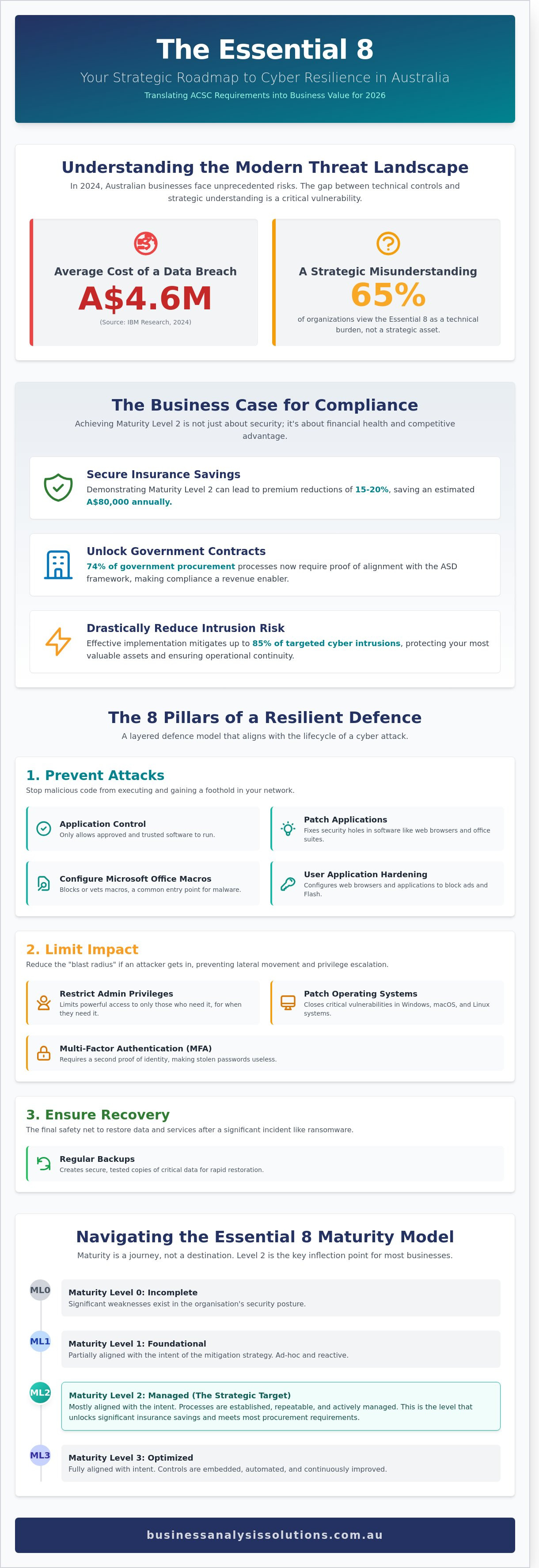
Functional categories within the framework ensure that even if a perimeter is breached, the lateral movement of an adversary is restricted. ACSC data indicates that implementing these eight controls effectively mitigates up to 85% of targeted cyber intrusions. The strategies work together through a layered defence model; they don't operate in isolation. Prioritisation focuses on prevention through application control and patch management, followed by limitation strategies like restricting administrative privileges and multi-factor authentication. Finally, regular backups ensure recovery is possible without paying ransoms or suffering permanent data loss.
Understanding the hierarchy is vital for strategic alignment. Prevention controls stop the initial execution of malicious code, while limitation controls reduce the "blast radius" once an intruder gains access. Data availability controls serve as the final safety net. This logical progression mirrors the lifecycle of a cyber attack, providing a methodical approach to risk reduction. By following this sequence, organisations ensure their investment targets the most critical vulnerabilities first, rather than wasting resources on low-impact security tools.
The Business Case for Compliance
Compliance directly influences financial outcomes and market positioning in the current Australian economy. Australian cyber insurance providers now frequently use the essential 8 maturity levels as a primary risk assessment tool. Organisations that demonstrate Maturity Level 2 or 3 often secure premium reductions of 15% to 20% compared to those without verified controls. Beyond insurance, 74% of government procurement processes now require proof of alignment with the ASD framework. This creates a clear link between security maturity and revenue generation.
Such alignment builds stakeholder trust through verified security maturity rather than vague promises. Strategic protection of intellectual property and operational continuity allows businesses to avoid the average A$4.6 million cost associated with a major data breach in the Australian market. When a crisis occurs, the difference between a minor disruption and a total business collapse often depends on the maturity of these eight controls. Investing in this framework is a pragmatic decision that protects the bottom line while ensuring long-term viability in an increasingly volatile digital environment.
The Eight Pillars: A Strategic Breakdown of Mitigation Strategies
Cybersecurity isn't a standalone technical hurdle; it's a core component of operational resilience. Effective implementation of the essential 8 requires moving beyond basic configuration to understand the underlying business logic of each control. When technical settings align with organizational workflows, security becomes an enabler rather than a friction point. The Australian Government's Essential Eight framework provides a prioritized roadmap to achieve this balance, focusing on three primary objectives: preventing attacks, limiting their impact, and ensuring rapid recovery.
Prevention Strategies: Stopping the Breach
Prevention is significantly more cost-effective than remediation. Application control serves as the first line of defense by ensuring only authorized software executes. This logic prevents 85% of targeted cyber intrusions by blocking unapproved scripts and installers. Patching applications is equally critical. The ACSC Annual Cyber Threat Report 2022-2023 highlights that the time between a vulnerability being disclosed and an exploit being released is shrinking. Organizations must aim to patch "extreme" risk vulnerabilities within 48 hours to close this window of opportunity.
Configure Microsoft Office Macro Settings: Macros are a frequent delivery method for malware. Restricting them to only digitally signed files from trusted locations neutralizes this vector.
User Application Hardening: This involves disabling unnecessary features in web browsers and PDF viewers, such as Java or web ads, which reduces the exploitable attack surface.
Limiting Impact: Restricting the Adversary
If a breach occurs, the goal shifts to containment. Restricting administrative privileges follows the principle of least privilege. In a typical Australian business, only a small percentage of staff require elevated access; limiting these rights prevents an attacker from moving laterally through the network. Patching operating systems maintains the integrity of your core ICT infrastructure, ensuring that known exploits cannot be used to escalate privileges. Multi-factor authentication (MFA) remains the most effective barrier against unauthorized access. It's reported that MFA can block over 99.9% of account compromise attacks, making it essential for any distributed work environment. Achieving strategic alignment of IT controls with user access requirements ensures security doesn't impede daily productivity.
Recovery: Ensuring Business Continuity
Backups are the final safeguard against total data loss and ransomware extortion. For an Australian small business, the average cost of cybercrime reached A$46,000 in 2023, a figure that escalates rapidly without a recovery plan. Robust backup strategies must go beyond simple storage. They require verified, air-gapped copies that are physically or logically separated from the main network to prevent them from being encrypted during an attack.
A mature recovery strategy relies on two key metrics:
Recovery Time Objective (RTO): The maximum acceptable duration of downtime. For critical systems, this should be measured in hours, not days.
Recovery Point Objective (RPO): The maximum age of files that must be recovered from backup storage for normal operations to resume.
Regularly testing these backups ensures the business can meet its RTO and RPO targets during a crisis. This methodical approach transforms backups from a background task into a verified solution for business continuity, providing the confidence needed to refuse ransom demands and restore operations with minimal financial impact.
Navigating the Essential Eight Maturity Model
The Australian Cyber Security Centre (ACSC) structures the essential 8 framework into four distinct maturity levels. These levels aren't a simple checklist. They represent a strategic progression designed to counter increasing levels of adversary sophistication. Level 0 signifies a total lack of effective controls. Level 1 focuses on commodity threats. Level 2 targets more determined adversaries using advanced tools. Level 3 addresses professional actors who specifically target your organisation. Selecting the right level depends on your specific risk profile and the value of the data you manage. A law firm handling A$50 million property settlements requires a different posture than a local retailer with minimal digital footprints.
Operating at Maturity Level 0 is an unacceptable business risk. The 2023 ASD Cyber Threat Report noted a 23% rise in cybercrime reports, with the average cost of a breach for small businesses reaching A$46,000. Level 0 means your systems are vulnerable to basic, automated scripts that any script-kiddie can deploy. It's a failure of corporate governance that leaves directors liable for negligence under the Corporations Act 2001. Transitioning from Level 0 to Level 1 isn't just a technical upgrade. It's a fundamental shift in operational hygiene that ensures your business isn't the easiest target in the Australian market. This progression requires a methodical approach to identifying assets and implementing baseline protections.
Maturity Level 1 vs. Level 2: The Practical Gap
Moving from Level 1 to Level 2 involves a shift from manual checks to centralised management. Level 2 requires automated software execution control and restricted administrative privileges. For a firm with 75 staff, licensing costs for enterprise-grade protection often range from A$18 to A$30 per user monthly. We recommend Level 2 as the baseline for most Australian businesses. Automation handles patch cycles that otherwise consume 15 hours of manual labour weekly, maintaining maturity without increasing headcount.
Conducting a Gap Analysis
A business efficiency diagnostic identifies weaknesses by mapping existing ICT solutions against framework requirements. This Essential Eight Compliance Guide highlights the practical application of these controls. We prioritise remediation based on risk and business impact. For instance, implementing multi-factor authentication offers the highest return on investment by blocking 99% of bulk phishing attacks. This structured approach ensures security investments align with strategic objectives and the essential 8 standards.
Step 1: Asset Discovery. Identify all software, hardware, and shadow IT currently operating within your network to establish a clear perimeter.
Step 2: Control Mapping. Evaluate your current security configurations against the ACSC maturity definitions to find specific technical deficiencies.
Step 3: Risk Quantification. Calculate the potential financial and operational impact of remaining at your current maturity level versus the cost of upgrades.
Step 4: Remediation Roadmap. Deploy automated solutions to bridge the gap to Level 2, focusing first on controls that mitigate the most frequent local threats.
Step 5: Continuous Monitoring. Establish a regular audit cycle to ensure that configuration drift doesn't degrade your maturity level over time.
A key part of this continuous monitoring and validation process is security testing, which actively probes your defenses for vulnerabilities. For organizations looking to understand this crucial step, a helpful beginner's guide to penetration testing can be found at penetrify.cloud.
Implementation Strategy: Aligning Security with Efficiency
Successful adoption of the essential 8 demands a phased roadmap that prioritises high-impact controls while preventing security fatigue. Research indicates that 35% of employees may circumvent security measures if they perceive them as barriers to their daily tasks. To counter this, organisations must integrate security controls directly into existing business processes through meticulous process mapping. This isn't a one-time project; it's a shift toward continuous compliance. Moving away from the traditional annual audit model allows for real-time risk mitigation and better alignment with international standards. In the 2022-23 financial year, the ACSC reported a 23% increase in cybercrime reports, highlighting the need for a dynamic posture. Transparent communication ensures that every team member understands their role in the broader security framework, turning security from a technical hurdle into an organisational habit. By focusing on stakeholder engagement early, firms can identify potential friction points before they impact productivity.
Step 1: Executive Buy-in and Governance
Cybersecurity is a fundamental risk management priority for the board, not just an IT issue. The 2023 ACSC Annual Cyber Threat Report stated the average cost of cybercrime for medium-sized Australian businesses is A$97,000 per report. Framing the essential 8 in terms of financial and reputational risk helps secure the necessary investment. Directors should assign clear ownership of specific pillars to ensure accountability. Budgeting must reflect the reality of both technical implementation and the long-term process management required to sustain Maturity Level 2 or 3 standards.
Step 2: Technical Configuration and Automation
Automation is the primary driver of efficiency in a modern security stack. Leveraging tools like Microsoft Intune allows for the automated patching of applications and operating systems across all endpoints. This reduces the manual workload for IT teams by approximately 40% while ensuring consistency. MFA implementation must be universal for remote access and accounts with high-level privileges. We use process mapping to ensure these technical hurdles don't disrupt legitimate work. If a security control creates a bottleneck, the configuration is refined to maintain both security and operational velocity.
Step 3: Training and Culture
Technical barriers are ineffective without a supportive organisational culture. Staff need to understand the logic behind macro restrictions and the necessity of MFA. Educating the workforce on the specific threats facing Australian sectors, where social engineering accounts for 25% of successful breaches, builds necessary awareness. Clear protocols for reporting potential incidents must be established and practiced. A "no-blame" culture ensures that if a staff member clicks a suspicious link, they report it within minutes. This rapid response can be the difference between a contained incident and a catastrophic data breach.
Optimising your security framework requires a balance of technical rigour and operational flow. Consult with our business analysts to align your Essential Eight strategy with your core business objectives.
The Role of a Fractional CIO in Essential 8 Success
Technical implementation of the essential 8 framework frequently fails when leadership treats it as a purely technical checklist. While IT teams focus on patch management and MFA settings, data from the ACSC 2022-2023 Cyber Threat Report indicates that 62% of Australian small-to-medium enterprises struggle to maintain these controls over a 12-month period. This failure stems from a lack of strategic oversight. A Fractional CIO provides the executive leadership required to move beyond basic compliance. They ensure that cybersecurity isn't an isolated IT project; it's a core component of the business's operational resilience.
These leaders act as a bridge between technical requirements and business objectives. They translate complex technical jargon into clear risk-management data. For example, implementing restricted administrative privileges reduces the likelihood of a total system lockout. This is a critical metric for business owners, considering the average cost of a cybercrime report reached A$46,000 for small businesses in 2023. By articulating this value, a Fractional CIO secures the necessary budget and stakeholder buy-in that technical teams often struggle to obtain.
External experts bring an unbiased lens to maturity assessments. Internal teams often suffer from confirmation bias, where they inadvertently overlook gaps in their own systems to meet deadlines. A Fractional CIO conducts a rigorous audit against the ACSC Maturity Model, identifying exactly where the organisation sits on the scale from Level 0 to Level 3. This objectivity is vital for insurance renewals and government contract tenders where proof of compliance is mandatory. It turns a "best effort" approach into a verifiable security posture.
Effective organisations view the essential 8 as the foundation of their Digital Transformation Blueprint. It provides a stable, secure platform upon which you can build advanced data analytics or AI capabilities. Without this foundation, any new digital initiative carries an unacceptable level of risk. A Fractional CIO ensures that as you scale, your security controls scale with you, preventing technical debt from becoming a security liability.
Strategic Alignment and ICT Solutions
Your security roadmap must support your long-term digital strategy. We select ICT solutions that offer native compliance with ACSC standards, reducing the need for expensive third-party bolt-ons. By focusing on controls with the highest risk-reduction ROI, such as application control and regular backups, we optimise your A$ investment. This methodical approach ensures every dollar spent directly lowers your organisation's threat profile while supporting business growth.
Ongoing Management and Reporting
Cybersecurity is not a "set and forget" task. We provide regular maturity reports to the board and external stakeholders to maintain transparency. As the ACSC updates the framework for 2026 and beyond, we adapt your implementation strategy to stay ahead of emerging threats. Continuous monitoring ensures your Level 2 or Level 3 status remains intact during audits. To begin your journey, Book a Fractional CIO Consultation to assess your Essential 8 maturity and secure your digital future.
Future-Proofing Your Enterprise With Strategic Cyber Maturity
Navigating the Australian threat landscape in 2026 requires a shift from basic compliance to operational excellence. The essential 8 framework provides the necessary structure, yet its success depends on precise execution across all eight mitigation pillars. Organizations that prioritize the maturity model today will gain a significant competitive advantage through reduced risk and enhanced stakeholder trust.
Business Analysis & Solutions leverages over 20 years of ICT consultancy experience to simplify this transition. We've spent two decades specializing in Australian cybersecurity standards, focusing specifically on bridging technical requirements with overarching business strategy. Our methodology ensures your security investments don't just protect data; they optimize your entire workflow. It's about creating a logical path from identified vulnerabilities to measurable strategic outcomes.
You don't have to manage these complexities in isolation. Request an Essential 8 Gap Analysis and Business Efficiency Diagnostic to gain a clear, objective view of your current posture. We're here to provide the analytical rigour and professional guidance your organization needs to thrive in an increasingly digital economy.
Frequently Asked Questions
Is the Essential Eight mandatory for all Australian businesses?
No, the Essential Eight isn't legally mandatory for all private Australian businesses, though it's required for non-corporate Commonwealth entities under the 2022 Protective Security Policy Framework. Many firms adopt it to meet contractual obligations or insurance requirements. Organizations regulated by APRA must also align with CPS 234; this standard shares core principles with the framework's baseline.
How much does it cost to implement the Essential Eight?
Implementation costs typically range from A$5,000 for small businesses to over A$150,000 for complex enterprises. These figures depend on existing infrastructure and the desired maturity level. Ongoing maintenance usually requires 10% to 15% of the initial investment annually. Precise costs are determined through a structured gap analysis that aligns technical remediation with specific business objectives.
What is the difference between Maturity Level 1 and Maturity Level 2?
Maturity Level 1 focuses on adversaries using common tools to target easy vulnerabilities, while Maturity Level 2 addresses more sophisticated actors who invest more time in their targets. Level 2 requires increased automation and more stringent controls; these include centralized logging and more frequent patching cycles. Transitioning between these levels involves moving from manual checks to integrated, policy-driven security management.
Can we achieve Essential Eight compliance using Microsoft 365 alone?
You can achieve approximately 70% to 80% of the essential 8 requirements using Microsoft 365 E5 licenses. While features like Intune and Defender cover application control and patching, gaps often remain in backup physical isolation and legacy system management. A comprehensive strategy requires supplementary tools or configurations to ensure every mitigation strategy meets the 2023 Australian Signals Directorate specifications.
How often should we assess our Essential Eight maturity?
You should conduct a formal maturity assessment at least every 12 months to account for evolving threats and infrastructure changes. High-risk organizations often perform quarterly reviews to maintain alignment with the ASD’s 2023 update. Regular internal audits ensure that security controls don't degrade over time; they remain effective against current adversary techniques. This frequency ensures your strategy remains proactive rather than reactive.
What happens if we can’t implement all eight strategies immediately?
Failing to implement all eight strategies increases your residual risk, as the framework is designed to work as an integrated suite. Organizations should prioritize the top three: application control, patching applications, and restricting administrative privileges. This phased approach allows you to address the most critical vulnerabilities first while developing a long-term roadmap for full compliance.
Does the Essential Eight protect against all types of cyber attacks?
The essential 8 provides a baseline for mitigating 85% of targeted cyber attacks but doesn't cover every possible threat. It focuses primarily on technical controls rather than social engineering, physical security, or insider threats. You must integrate these strategies into a broader cybersecurity program that includes user awareness training and robust incident response plans.
A comprehensive security posture also extends these digital principles to physical access points. Just as multi-factor authentication protects your data, modern entry systems secure your premises. For those interested in how this technology is evolving, you can check out AN Digital Lock for examples of advanced physical security solutions.
How does the Essential Eight relate to the ISO 27001 standard?
The Essential Eight acts as a technical subset of the broader ISO 27001 Information Security Management System. While ISO 27001 provides a high-level governance framework, the ASD strategies offer specific, technical implementation steps for Australian environments. Mapping these controls to ISO 27001 Annex A helps organizations demonstrate compliance with both local and international benchmarks.



Comments