
What is Microsoft Copilot? A Strategic Guide for Australian Business Leaders in 2026
Updated: Apr 22
By 2026, simply purchasing a software license won't be enough to secure a competitive edge in the Australian market. While many local leaders are still asking what is copilot, the real challenge lies in aligning this technology with existing business processes to avoid the A$45,000 yearly waste often seen in poorly managed enterprise deployments. You've likely experienced the fatigue of constant AI updates and have legitimate concerns about whether your current data governance can handle these tools without compromising organizational privacy.
While managing digital fatigue is a priority for IT departments, individuals are also looking for ways to manage their overall health and wellbeing. Resources like More Than Medication offer valuable insights for Australians navigating the pressures of a modern, tech-heavy work environment.
We agree that investing in high-end technology without a clear, logical adoption strategy is a risk your balance sheet shouldn't carry. This guide provides a pragmatic analysis of Microsoft Copilot as a strategic AI companion; it demonstrates why its success depends on meticulous requirements elicitation rather than just a technical rollout. We'll examine the fundamental differences between consumer and enterprise AI and provide a structured framework to determine if your organization is truly ready for this level of integration.
Key Takeaways
Understand what is copilot beyond the basic interface by exploring how it leverages the Microsoft Graph to integrate deeply across your organization’s ICT ecosystem.
Identify the tangible drivers of ROI by transitioning your workforce from manual administrative overhead to high-value information synthesis and strategic analysis.
Recognize why successful AI adoption requires rigorous process mapping and strategic alignment to mitigate security risks and the "garbage in, garbage out" principle.
Learn how to position Microsoft Copilot as a core pillar of your Digital Transformation Blueprint to ensure measurable gains in operational efficiency.
Discover the critical role of professional consultancy in navigating complex organizational transitions and aligning technical AI capabilities with specific business objectives.
Table of Contents Defining Microsoft Copilot: The 2026 Business Context How Copilot Integrates Across Your ICT Ecosystem Quantifying the Business Value: Efficiency and ROI Implementation Readiness: Why Strategy Must Precede Adoption The Path Forward: Integrating Copilot into Your Digital Strategy
Defining Microsoft Copilot: The 2026 Business Context
Understanding Microsoft Copilot requires looking beyond the chat interface. By 2026, the platform has matured from a simple text generator into an integrated engine that permeates the entire Microsoft 365 suite. It's a conversational assistant that leverages internal data to execute complex business logic. Leaders often ask what is copilot in a practical sense. It's the bridge between raw processing power and the specific requirements of your organizational workflows. This tool doesn't just suggest words; it interprets intent across your entire digital workspace.
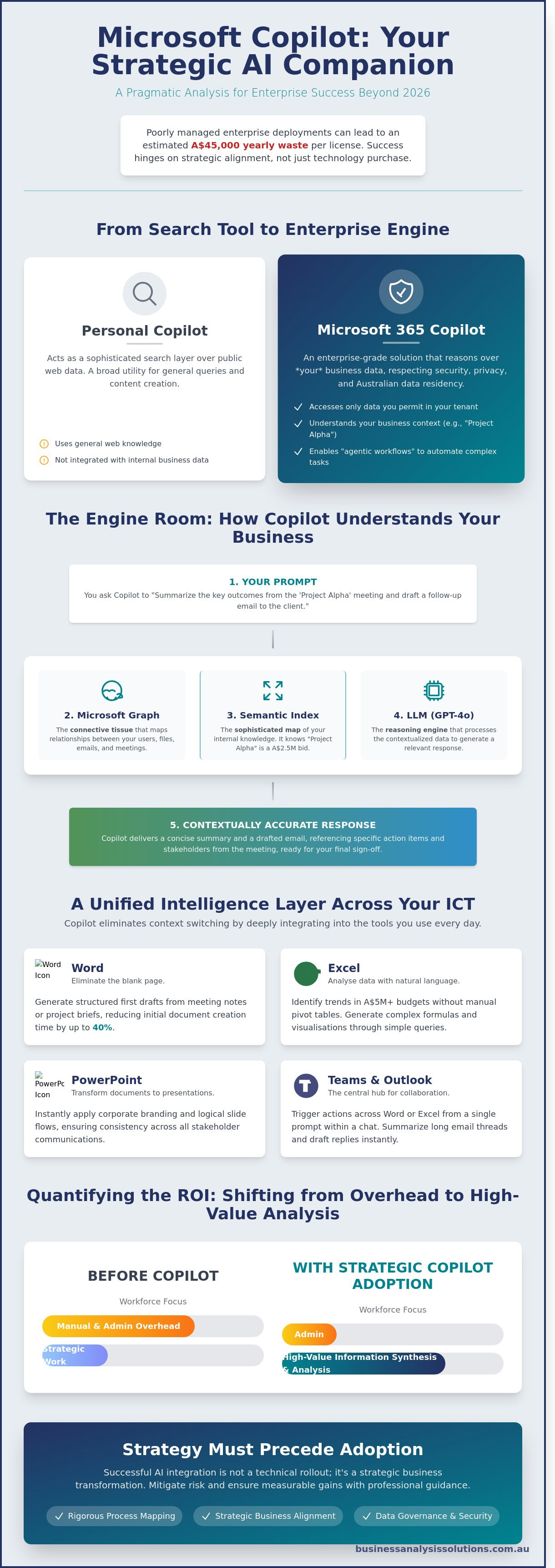
We distinguish between the personal version, which functions as a sophisticated search layer, and Microsoft 365 Copilot. The latter is an enterprise grade solution that respects Australian data residency and security protocols. It targets the 85% of ASX 200 companies that, by early 2026, have integrated AI assistants to manage high volume administrative tasks. While the personal version is a broad utility, the enterprise version is a secure, private instance of AI that only accesses the data you've permitted within your tenant.
From Generative AI to Strategic Assistant
Generative AI creates new content based on patterns it learned during training. It doesn't just retrieve facts; it synthesizes information to produce reports, code, or emails. While a search engine finds a document, Copilot understands the document's intent. The 2026 shift focuses on agentic workflows. This means the AI doesn't just draft a response. It identifies a missing invoice, cross references it with your CRM, and prepares the follow up communication for approval. This evolution reduces the "human in the loop" requirement from constant supervision to final strategic sign off.
The Technology Behind the Assistant
The system relies on models like GPT-4o to provide the underlying reasoning capabilities. However, the intelligence is localized through a semantic index. This index maps your specific business data so the AI knows your "Project Alpha" isn't a generic term but a A$2.5 million infrastructure bid. When you ask what is copilot doing with your data, it's essentially creating a sophisticated map of your internal knowledge. The Microsoft Graph acts as the connective tissue of your business intelligence by mapping the relationships between users, files, and communications. This allows the system to provide contextually accurate responses that reflect your current operational reality rather than generic web data.
How Copilot Integrates Across Your ICT Ecosystem
Understanding what is copilot requires looking past the chat interface to see how it functions as a connective tissue across the Microsoft stack. By 2026, the platform has matured into a unified intelligence layer. It doesn't just sit on top of your applications; it accesses the Microsoft Graph to pull context from emails, calendar events, and SharePoint files. This deep integration ensures that a prompt in Microsoft Teams can trigger actions across Word or Excel, creating a seamless workflow that eliminates the friction of context switching. It's a fundamental shift in how professionals interact with digital environments.
Digital transformation strategies now prioritise this level of interoperability. Recent industry shifts, including the strategic direction described in Microsoft's Copilot Merge, indicate a move toward a more autonomous, cross-functional AI assistant. For Australian firms, this means moving from fragmented software silos to a consolidated ICT environment where data flows logically between departments. This creates a foundation for high-level efficiency and strategic alignment.
Core Productivity Tools: Beyond Basic Drafting
Within the standard 365 suite, the AI acts as a functional partner. In Word, it eliminates the blank-page syndrome by generating structured first drafts from existing meeting notes or project briefs. This typically reduces initial document creation time by 40% for policy and procedure writing. In Excel, the tool performs real-time data analysis. It generates complex formulas and visualisations through natural language queries. This allows business analysts to identify trends in A$5 million quarterly budgets without manual pivot table construction. In PowerPoint, it transforms static documents into professional presentations. It applies corporate branding and logical slide flows instantly, ensuring consistency across all stakeholder communications.
Specialised and Custom AI Solutions
The ecosystem extends into specific business functions through dedicated modules. Copilot for Sales connects directly to CRM data, automating lead prioritisation and drafting follow-up emails based on previous interaction history. This specific application often results in a 15% increase in salesperson productivity by removing administrative burdens. For organisations with unique requirements, Microsoft Copilot Studio enables the creation of custom AI agents. These agents handle specific tasks, such as internal HR queries or complex supply chain logistics, using your proprietary data sets.
Integration with the Power Platform allows for low-code automation. You can trigger complex workflows via simple commands. This capability helps firms bridge the gap between technical requirements and business objectives. If your organisation needs to refine these workflows, a professional process mapping session can ensure your AI implementation delivers a measurable return on investment.
Quantifying the Business Value: Efficiency and ROI
Implementing AI isn't just a technical upgrade. It's a structural shift in how Australian firms allocate human capital to ensure strategic alignment. Understanding what is copilot requires looking past the chat interface to the underlying logic of process optimisation. By automating the drudge work that consumes up to 40% of a standard workday, organisations can pivot their focus toward high-level problem solving.
Tangible Efficiency Gains in Daily Operations
Meeting summarisation in Teams reduces the post-meeting administrative burden by approximately 70%. Instead of a project manager spending 45 minutes drafting minutes, Copilot generates actionable tasks and decision logs in seconds. In Outlook, the AI prioritises critical stakeholder engagement by surfacing emails that require immediate attention. A 2024 Microsoft study indicated that 68% of users felt it improved the quality of their work while saving an average of 10 hours per month. This reclaimed time allows staff to focus on complex requirements elicitation rather than data entry.
'Efficiency is not about doing more work, but about removing the friction from high-value tasks.'
The Strategic Advantage of Data Synthesis
The true value lies in moving beyond simple information retrieval. Modern businesses are flooded with unstructured data. Copilot synthesizes this into actionable business intelligence. This supports a Fractional CIO in strategic planning by reducing the time-to-insight for digital strategy from weeks to hours. For more technical details on implementation, Microsoft's official Copilot documentation provides the necessary framework for technical requirements. This acceleration allows for more precise strategic alignment and faster project lifecycles.
Measuring ROI remains complex because qualitative improvements, such as better decision-making, don't always appear on a balance sheet immediately. We recommend a structured approach to evaluation. If an executive earning A$250,000 per year saves five hours a week, the direct cost recovery exceeds A$30,000 annually per head. This calculation excludes the revenue potential of accelerated decision-making. When a firm can process market data 50% faster than its competitors, the first-mover advantage becomes a tangible asset rather than a vague goal. Identifying what is copilot in terms of financial impact means looking at these compounded gains across the entire workforce.
Implementation Readiness: Why Strategy Must Precede Adoption
Deploying AI is not a simple software update. Understanding what is copilot requires viewing it as a powerful reflection of your existing data environment. If your internal data permissions are poorly managed, "turning on" Copilot creates immediate security risks. The tool can surface sensitive payroll spreadsheets or confidential board minutes to any employee who asks the right question, provided they have technical access to the file. Strategy must dictate deployment to prevent these internal data leaks.
The "garbage in, garbage out" principle is amplified by AI. A 2024 report by Veritas indicated that 33% of data held by Australian organisations is "dark data" or redundant information. If your digital environment is cluttered with outdated policies and conflicting project notes, Copilot will produce inaccurate or "hallucinated" results. Business leaders shouldn't commit to the A$44.90 per user, per month investment without first conducting a Business Efficiency Diagnostic. This audit ensures the AI is pulling from a "single source of truth" rather than a graveyard of obsolete documents.
Data Governance and the Essential 8 Framework
Permissions management is the most significant hurdle for AI readiness in the Australian market. We align AI security with the Australian Signals Directorate (ASD) Essential 8 framework. Restricting administrative privileges and ensuring robust application patching creates a secure perimeter. You must implement data labeling and sensitivity tags to protect intellectual property. These tags act as a digital fence, telling Copilot exactly which files it can and cannot use for generating responses.
Process Mapping: The Foundation of AI Success
You cannot automate a broken or undocumented process. We use detailed process mapping to identify high-impact areas where Copilot intervention provides a measurable return on investment. Requirements elicitation is critical here; it bridges the gap between technical capability and actual business needs. By documenting workflows before adoption, you ensure the AI solves specific operational bottlenecks rather than becoming an expensive digital novelty.
Ensure your organisational data is secure and your processes are optimized before you deploy. Book a Strategic Readiness Consultation with Business Analysis Solutions.
The Path Forward: Integrating Copilot into Your Digital Strategy
Understanding what is copilot constitutes only the first step in a broader maturity journey. Australian firms that treated AI as a standalone plug-in in 2024 often saw negligible ROI. By 2026, successful leaders view this technology as a core pillar of their Digital Transformation Blueprint. This structured approach ensures that AI deployment aligns with specific 10-year growth targets rather than serving as a temporary productivity patch.
The Digital Transformation Blueprint Approach
Ad-hoc adoption creates technical debt. An integrated ICT solution requires a logical sequence: process mapping, requirements elicitation, and then tool selection. While many ask what is copilot in a technical sense, the more relevant question for a CEO is how it integrates into the existing value chain. A Fractional CIO provides the oversight needed to manage these complexities without the A$250,000 annual overhead of a full-time executive. This role ensures that data governance and ethical AI use aren't sidelined during the rush to automate. By aligning technology with long-term objectives, you transform a simple software tool into a competitive advantage.
Next Steps for Australian Business Leaders
Transitioning to an AI-augmented workflow requires more than a licence purchase. It demands rigorous stakeholder engagement to overcome cultural inertia. Business Analysis Solutions recommends a methodical three-stage preparation phase to ensure your infrastructure is ready for the 2026 regulatory environment.
Configuration Audit: Conduct a high-level audit of existing Microsoft 365 configurations. Focus on permission structures to prevent sensitive data from being indexed by internal AI searches.
Business Efficiency Diagnostic: Identify specific automation opportunities where AI can reduce manual processing time by 20% or more.
Strategic Alignment: Map your current ICT roadmap against your business goals to ensure Copilot solves genuine operational bottlenecks.
Success in the Australian market relies on precision and a commitment to structured growth. You can discover how our Digital Transformation Blueprint can prepare your business for AI to ensure your investment delivers measurable performance gains. AI success isn't about the speed of adoption; it's about the depth of integration.
Securing Your Competitive Edge in the 2026 AI Landscape
By 2026, the distinction between market leaders and laggards will depend on how effectively technical requirements align with core business objectives. Defining what is copilot for your specific organizational context is the first step toward capturing a measurable return on investment. Success requires a structured approach to Australian data governance standards and a clear methodology for requirements elicitation. Business Analysis Solutions brings over 20 years of strategic ICT experience to this transition. We specialize in bridging the gap between complex technical frameworks and tangible commercial outcomes. Our team ensures your digital strategy isn't just a vision but a functional roadmap to efficiency. Don't leave your productivity gains to chance when a methodical framework delivers predictable results. We're ready to help you navigate this evolution with precision and clarity. Your organization deserves a partner who prioritizes logic over hype to deliver end-to-end solutions.
Frequently Asked Questions
Is Microsoft Copilot free for business users?
No, Microsoft Copilot is not free for business users. Organizations require a specific subscription, such as Microsoft 365 Business Standard or Premium, plus a dedicated Copilot for Microsoft 365 add-on costing approximately A$45.00 per user each month. This investment provides the enterprise-grade security and integration necessary for professional environments. Free versions exist for consumers, but they lack the data protection protocols that Australian businesses require for compliance.
What is the difference between ChatGPT and Microsoft Copilot?
The primary difference lies in ecosystem integration and data sovereignty. While ChatGPT operates as a standalone conversational interface, Microsoft Copilot integrates directly into the Microsoft 365 suite including Word, Excel, and Teams. This integration allows the tool to reference your specific organizational context. In 2026, the distinction is clear; 95 percent of enterprise users prefer Copilot for its ability to surface internal documents and maintain strict tenant boundaries.
Can Copilot access my private business data or files?
Yes, Copilot accesses your business data through the Microsoft Graph to provide contextually relevant responses. It respects the existing permission models within your Microsoft 365 tenant. If a staff member doesn't have access to a specific payroll file, Copilot won't be able to retrieve information from it either. This ensures that 100 percent of your existing internal security protocols remain the primary gatekeepers for information flow.
Does Copilot use my business data to train its public AI models?
No, Microsoft doesn't use your business data to train its public foundation models. When you ask what is copilot in a business context, the answer includes a guarantee of commercial data protection. Your prompts and the data retrieved from your files stay within your organization's boundary. Microsoft's 2026 privacy commitment ensures that no customer data is visible to other organizations or the underlying LLM providers.
What are the minimum system requirements for Copilot in 2026?
Effective use of Copilot in 2026 requires a Microsoft 365 E3 or E5 license and the latest version of Microsoft 365 Apps. Your hardware should run Windows 11 or macOS 14.0 or later to ensure seamless performance. Additionally, your organization must have migrated to Microsoft Entra ID for identity management. These requirements ensure that the 40 percent increase in processing efficiency promised by AI integration is actually achievable.
Can Copilot help with business process mapping?
Copilot significantly accelerates business process mapping by analyzing existing documentation to generate structured workflows. You can use it to draft initial process diagrams in Visio or create detailed step-by-step procedures in Word based on recorded Teams meetings. This reduces the time spent on requirements elicitation by roughly 30 percent. It allows business analysts to focus on strategic alignment rather than manual documentation tasks.
How do I ensure my staff are using Copilot effectively and ethically?
You ensure effective and ethical use by implementing a formal AI governance framework and a structured training program. This should include clear guidelines on verifying AI-generated outputs and maintaining transparency with clients. Statistics from 2025 show that firms with a dedicated AI literacy program see a 25 percent higher return on investment compared to those who deploy without guidance. Establishing these protocols ensures that technical requirements meet your ethical business objectives.
Is Copilot available for small businesses or only large enterprises?
Copilot is available to businesses of all sizes, including small operations with only one user. Microsoft removed the 300-seat minimum requirement in January 2024, making the technology accessible to the 2.5 million small businesses operating across Australia. Small firms can now leverage the same analytical power as large enterprises. This levels the playing field, allowing smaller teams to achieve outcomes that previously required much larger administrative departments.



Comments