Automation Project Management: A Strategic Checklist for Business Efficiency
Updated: Apr 22
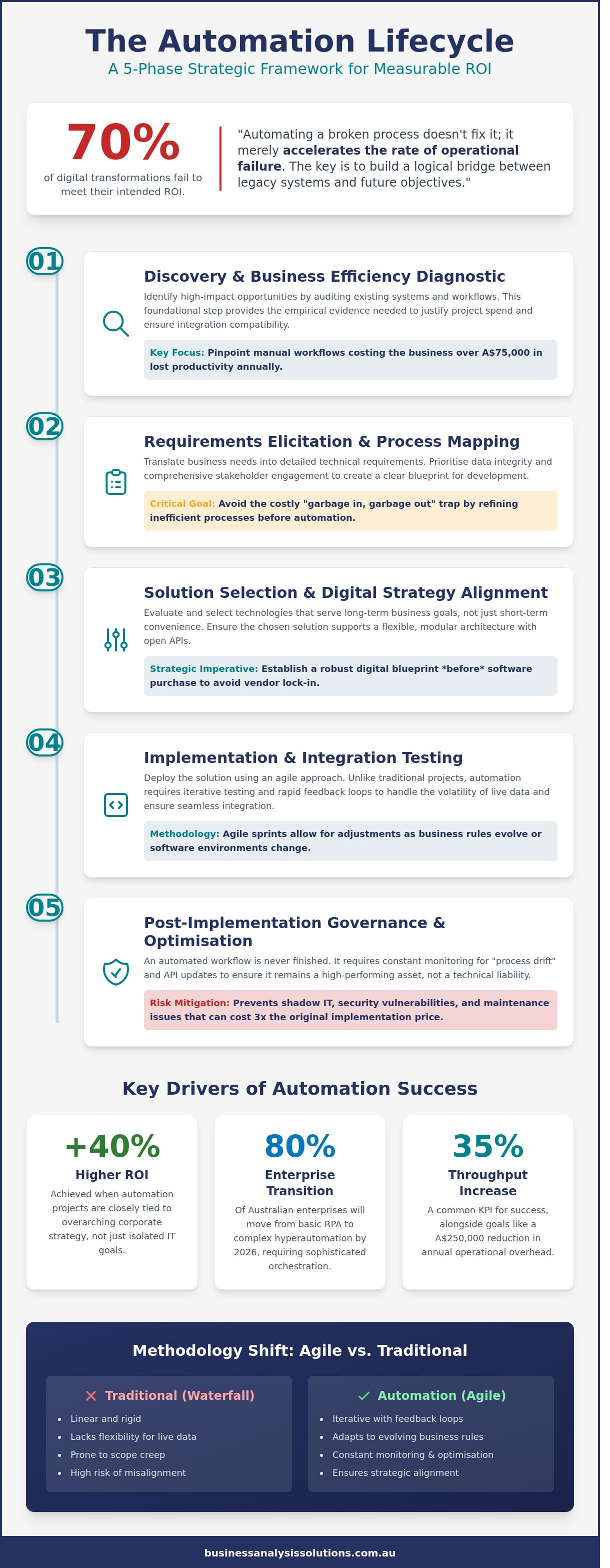
Automating a broken process doesn't fix it; it merely accelerates the rate of operational failure. Recent industry analysis from 2023 shows that 70% of digital transformation initiatives fail to meet their intended ROI due to poor strategic alignment. Effective automation project management requires more than just new software; it demands a logical bridge between your existing legacy systems and your future state objectives. Many Australian business leaders hesitate to move forward because they fear digitising inefficient workflows or lack the internal technical expertise to manage the transition.
We understand that the complexity of fragmented systems can feel overwhelming. You need a solution that delivers a reduced manual workload without compromising process integrity. This article provides a structured checklist to help you master these complexities and ensure every technical deployment translates into measurable business value. We'll explore a clear roadmap for implementation that facilitates seamless integration between your business units and secures a tangible return on your investment.
Key Takeaways
Navigate the evolution of end-to-end process orchestration through a structured five-phase strategic framework designed for the Australian business landscape.
Ensure long-term technical success by prioritising data integrity and comprehensive stakeholder engagement during the requirements elicitation phase.
Avoid the costly "garbage in, garbage out" trap by identifying and refining inefficient processes before they are integrated into complex legacy systems.
Optimise your automation project management with professional oversight to ensure every technical solution aligns with strategic business objectives and measurable ROI targets.
Table of Contents What is Automation Project Management in 2026? The Automation Lifecycle: A Five-Phase Strategic Framework Essential Checklist for Automation Project Success Managing Risks and Avoiding Automation Failure Implementing Automation with Professional Oversight
What is Automation Project Management in 2026?
By 2026, 80% of Australian enterprises have transitioned from basic robotic process automation to complex hyperautomation. This shift necessitates a sophisticated synthesis of business analysis and ICT project management. It isn't just about replacing manual data entry with scripts. Effective automation project management now focuses on end-to-end process orchestration across disparate cloud environments and legacy systems. This ensures that every automated step contributes to a larger, unified business objective rather than creating isolated islands of efficiency.
Strategic alignment remains the primary predictor of success. Research indicates that projects closely tied to corporate strategy deliver 40% higher ROI than those driven solely by IT departments. This is why the role of a digital transformation consultant is critical. These experts bridge the gap between technical requirements and business goals, ensuring that automation solves real operational bottlenecks. They provide the clarity needed to navigate complex integrations while maintaining a focus on the bottom line.
The Core Objectives of Automation Management
Management must prioritize technical scalability across the entire ICT environment. This involves establishing clear KPIs for operational efficiency, such as a targeted A$250,000 reduction in annual overhead or a 35% increase in throughput. Leaders must also mitigate the risks of technical debt. When bots are deployed without a long-term governance framework, they often lead to shadow IT. This creates security vulnerabilities and maintenance nightmares that can cost an organisation three times the original implementation price within two years.
To mitigate these risks and ensure a stable environment for new deployments, it is helpful to discover Landmark Technologies, an MSP that provides specialized IT infrastructure and support solutions designed to handle complex business needs.
Automation vs. Traditional Project Management
Linear Waterfall methods often fail in this space because they lack the flexibility to handle the volatility of live data. Automation project management demands iterative testing and rapid feedback loops. Unlike traditional software delivery, the lifecycle of an automated workflow is never truly finished. It requires constant monitoring for "process drift" and API updates. Teams must manage these unique lifecycles through an agile lens, allowing for adjustments as business rules evolve or software environments change. This proactive approach prevents system failures and ensures the automation remains a high-performing asset.
The Automation Lifecycle: A Five-Phase Strategic Framework
Successful automation project management doesn't happen by accident; it's the result of a rigorous, five-phase lifecycle designed to mitigate risk and ensure a measurable return on investment. This methodical approach ensures that technical deployments resolve actual business bottlenecks rather than merely digitising inefficient manual processes. By following a structured path, organisations can move from abstract operational challenges to concrete, scalable outcomes. The framework consists of five critical stages:
Phase 1: Discovery and Business Efficiency Diagnostic
Phase 2: Requirements Elicitation and Process Mapping
Phase 3: Solution Selection and Digital Strategy Alignment
Phase 4: Implementation and Integration Testing
Phase 5: Post-Implementation Governance and Optimisation
The Discovery and Diagnostic Phase
The Business Efficiency Diagnostic is the foundational step for all automation. This phase focuses on identifying high-impact opportunities where immediate efficiency gains can be realised, such as manual workflows currently costing the business upwards of A$75,000 in lost productivity annually. We audit existing legacy systems to confirm integration compatibility, ensuring that any new automation layer won't create isolated data silos. This diagnostic provides the empirical evidence needed to justify the project spend. If you're seeking this level of precision, optimising your business architecture starts with this analytical deep dive.
Technical Selection and Strategy
Selecting the right ict solutions requires evaluating software against long-term business goals rather than short-term convenience. It's critical to avoid the trap of vendor lock-in by prioritising flexible architecture and open APIs that allow for future modularity. A robust digital transformation blueprint must be established before any software purchase occurs to ensure the technology serves the strategy, not the other way around. Effective automation project management relies on this alignment to prevent the technical debt that affects 45% of large-scale IT deployments in the Australian market. By establishing clear requirements and mapping processes early, you ensure the chosen solution integrates seamlessly with your existing operational ecosystem.
Once selection is finalised, the focus shifts to implementation and integration testing. This phase involves rigorous stress-testing of the automation logic against real-world scenarios to prevent deployment failures. Post-implementation governance then ensures the system remains optimised as business needs evolve. This lifecycle provides the steady, logical progression required to turn complex organisational requirements into streamlined, automated realities.
Essential Checklist for Automation Project Success
Effective automation project management requires a transition from theoretical design to rigorous operational execution. Success isn't found in the software itself; it's found in the integrity of the environment where that software lives. Data integrity remains the primary hurdle for Australian firms. A 2023 Gartner study found that poor data quality costs organisations an average of A$19.7 million annually. You must cleanse and validate all source data before any automated flows are activated. Automating a broken process or using corrupted data only accelerates the rate of error.
Compliance with local regulations is a non-negotiable requirement. Every automated workflow must align with the Privacy Act 1988 and the Australian Privacy Principles (APPs). This is especially critical when handling personally identifiable information (PII) or financial records. Security protocols should be baked into the architecture, ensuring that automated access points don't create vulnerabilities in your network perimeter.
Stakeholder and Change Management
Digital transformation often fails due to cultural resistance rather than technical flaws. McKinsey reports that 70% of change programmes fail to reach their goals because of employee resistance. To mitigate this, develop a communication plan that reaches every user affected by the change. You're not just replacing tasks; you're shifting responsibilities. Training staff to manage and monitor these new systems is essential. They need to understand the logic behind the automation to troubleshoot effectively when anomalies occur.
Identify all cross-functional stakeholders, from front-line users to IT security teams.
Execute a transparent communication strategy that explains the "why" behind the shift.
Provide structured upskilling sessions to move staff from manual processing to system oversight roles.
Technical and Operational Readiness
Technical readiness involves more than a successful pilot test. It requires granular "as-is" versus "to-be" process mapping to identify every possible logic branch. You must verify API availability and system interoperability across all legacy software. Approximately 30% of integration projects stall because of undocumented API limitations. Robust automation project management also demands clear fallback procedures. If a system failure occurs, your team needs a pre-defined manual override to maintain business continuity without data loss.
Document every step of the process map to ensure no edge cases are missed.
Test API calls under peak load conditions to ensure stability.
Establish a "fail-safe" protocol that reverts to manual processing if the automation hits a critical error.
Managing Risks and Avoiding Automation Failure
Effective automation project management requires a ruthless focus on process integrity before a single line of code is written. The principle of "Garbage In, Garbage Out" remains the primary cause of project collapse. Automating an inefficient, manual process does not fix the underlying logic; it merely accelerates the rate of error. A 2023 study by Deloitte Australia found that 30% of automation pilots fail to deliver the expected ROI because the original process was never optimised for a digital environment.
Underestimating the technical debt within legacy systems is another critical risk. Many Australian firms operate on core systems that are over 10 years old. These environments often lack the APIs necessary for modern integration, leading to fragile workarounds. Without a formal requirements document that defines every touchpoint and exception, these technical bottlenecks will stall progress. Precision in requirements elicitation ensures that the solution addresses business reality rather than an idealised workflow.
Common Pitfalls in Implementation
Rushing to the tool selection phase is a strategic error that leads to project bloat. When organisations prioritise software features over process mapping, they often pay for capabilities they cannot use. Poor process mapping can extend project timelines by as much as 45% as developers encounter undocumented exceptions. Identifying these bottlenecks during the initial discovery phase prevents costly mid-project pivots and keeps the budget aligned with the initial A$50,000 to A$150,000 investment typical for mid-scale Australian deployments.
Governance and Long-term Stability
Automation isn't a "set and forget" solution. It requires a defined governance structure to ensure long-term stability. Assigning clear ownership for monitoring automated workflows prevents "silent failures" where a bot stops functioning due to a minor UI change in a connected application. Strategic technology reviews should occur every 90 days to ensure the automation remains aligned with evolving business objectives. This cadence allows for proactive adjustments, maintaining the integrity of the automation project management framework and ensuring the technology continues to drive tangible value.
To ensure your next initiative avoids these common pitfalls, engage our experts for a comprehensive process audit and automation strategy.
Implementing Automation with Professional Oversight
Success in automation isn't about buying software; it's about engineering a strategic ICT ecosystem. Many Australian mid-market firms fall into the trap of applying tactical fixes to systemic problems, which often leads to fragmented data and redundant workflows. By engaging a Fractional CIO, your organisation gains access to high-level strategic leadership without the A$250,000 plus annual salary of a full-time executive. This role bridges the gap between technical requirements and business objectives, ensuring that every automation project management initiative aligns with long-term growth and operational stability.
Moving from isolated tools to an integrated framework requires a structured approach. We leverage over 20 years of expertise in business analysis to transform how companies handle data and process flow. A tailored Digital Transformation Blueprint acts as the foundation for this change. It ensures project ROI by validating that every technology investment solves a verified business pain point rather than just adding another layer of complexity to your stack.
Why Professional Consultancy Matters
Professional oversight provides an objective lens for software vendor evaluation. It's common for internal teams to be swayed by flashy marketing features rather than functional suitability. Our methodology prioritises precision in requirements elicitation and process mapping. This rigorous analysis eliminates ambiguity before a single subscription is started or a line of code is written. By conducting an independent evaluation of ICT solutions, we ensure the chosen tools fit your specific Australian regulatory environment and industry standards. This level of detail reduces the risk of project failure, which currently affects approximately 70% of digital transformations globally.
Next Steps for Your Organisation
The path to sustainable, scalable automation begins with a clear understanding of your current state. You shouldn't invest in technology until you've identified the specific bottlenecks affecting your bottom line. A Business Efficiency Diagnostic provides this clarity, pinpointing gaps in your current processes and identifying where automation will yield the highest returns.
Once these gaps are identified, we develop a roadmap that moves beyond simple task automation toward a fully integrated digital environment. This ensures your systems grow alongside your business. You can contact Business Analysis & Solutions for expert project oversight to ensure your next initiative delivers measurable performance gains and a seamless transition to automated operations.
Securing Your Competitive Edge through Strategic Automation
Success in automation project management requires a rigorous adherence to the five-phase strategic framework. This methodical approach ensures technical implementations deliver a tangible return on investment rather than becoming costly liabilities. Organizations must prioritize strategic ICT alignment and thorough process mapping to avoid the common pitfalls that lead to project failure. By 2026, the gap between market leaders and laggards will be defined by the precision of their execution.
Business Analysis & Solutions leverages 20+ years of industry experience to help Australian firms navigate these complexities. We've built a reputation for bridging the gap between technical requirements and business objectives with a direct, no-nonsense approach. Our methodology focuses on removing ambiguity and delivering end-to-end results that strengthen your bottom line. It's time to move beyond the checklist and implement a roadmap built for performance.
Request Your Business Efficiency Diagnostic today to ensure your systems are optimized for the long term. We're ready to help you transform organizational complexity into a streamlined, profitable operation.
Frequently Asked Questions
What is automation project management?
It's the application of structured methodologies to plan, execute, and monitor the integration of automated technologies into business workflows. Effective automation project management ensures that technical solutions align with strategic business objectives. This process involves rigorous requirements elicitation and stakeholder engagement to identify where manual tasks can be replaced by software. By maintaining a logical framework, project managers bridge the gap between technical possibilities and commercial reality.
How do you ensure an automation project delivers ROI?
You ensure ROI by establishing a clear financial baseline before implementation and measuring performance against specific KPIs like a 25% reduction in manual processing time. We calculate the return on investment by comparing the total cost of ownership, including licensing and maintenance, against the tangible hours saved. A successful project should target a payback period of less than 18 months. This methodical approach prevents scope creep and ensures every automated step contributes to the bottom line.
Why is process mapping important before starting automation?
Process mapping identifies inefficiencies that automation would otherwise only accelerate. By documenting every step in a workflow, we uncover bottlenecks that require rectification before any code's written. Automating a broken process creates a faster, more expensive broken process. Our analysis shows that 40% of automation failures stem from poorly defined manual workflows. Mapping ensures the technical solution's built on a foundation of logic and streamlined operations.
What are the biggest risks in automation implementation?
The primary risks include technical debt from poor integration and low user adoption rates. Data indicates that 30% of automation projects fail because they don't account for how staff interact with the new systems. Another risk is the lack of a scalable architecture, which limits future growth. We mitigate these risks through rigorous testing and a structured change management plan that prioritises clear communication with all internal stakeholders.
Can automation project management be handled by an internal team?
Internal teams can handle automation project management if they possess the specialized skills required for requirements elicitation and vendor management. However, internal staff often struggle to maintain objectivity or lack the time to manage complex integrations alongside their daily duties. Engaging an external partner provides a neutral perspective and ensures the project remains on schedule. This avoids the common 15% delay seen in projects managed by overstretched internal departments.
How long does a typical automation project take to implement?
A standard automation project typically takes between 12 and 24 weeks from initial discovery to final deployment. The discovery and process mapping phase usually consumes the first 4 weeks. This is followed by an 8 week development cycle and a 4 week testing period. Larger enterprise wide integrations may extend to 36 weeks. Maintaining this timeline requires strict adherence to the project scope and prompt feedback from decision makers during the validation stages.
What is the role of a Fractional CIO in automation?
A Fractional CIO provides the high level strategic alignment needed to ensure automation investments support long term business goals. They act as a bridge between the executive board and the technical team, translating complex requirements into actionable plans. For a fixed monthly fee, often starting at A$3,000, they offer the expertise of a full time executive without the associated overhead. This role's crucial for maintaining architectural integrity across the entire technology stack.
What happens if our existing legacy systems cannot be automated?
We utilise Robotic Process Automation (RPA) or middleware solutions to create an interface with legacy systems that lack modern APIs. RPA mimics human interaction with the software, allowing data to flow between old and new platforms without requiring a total system overhaul. If a system's over 15 years old and technically obsolete, we develop a phased migration strategy. This ensures business continuity while gradually moving critical functions to a more flexible, automated environment.



Comments