How to Develop a Digital Strategy for Business Growth in 2026
Updated: Apr 21
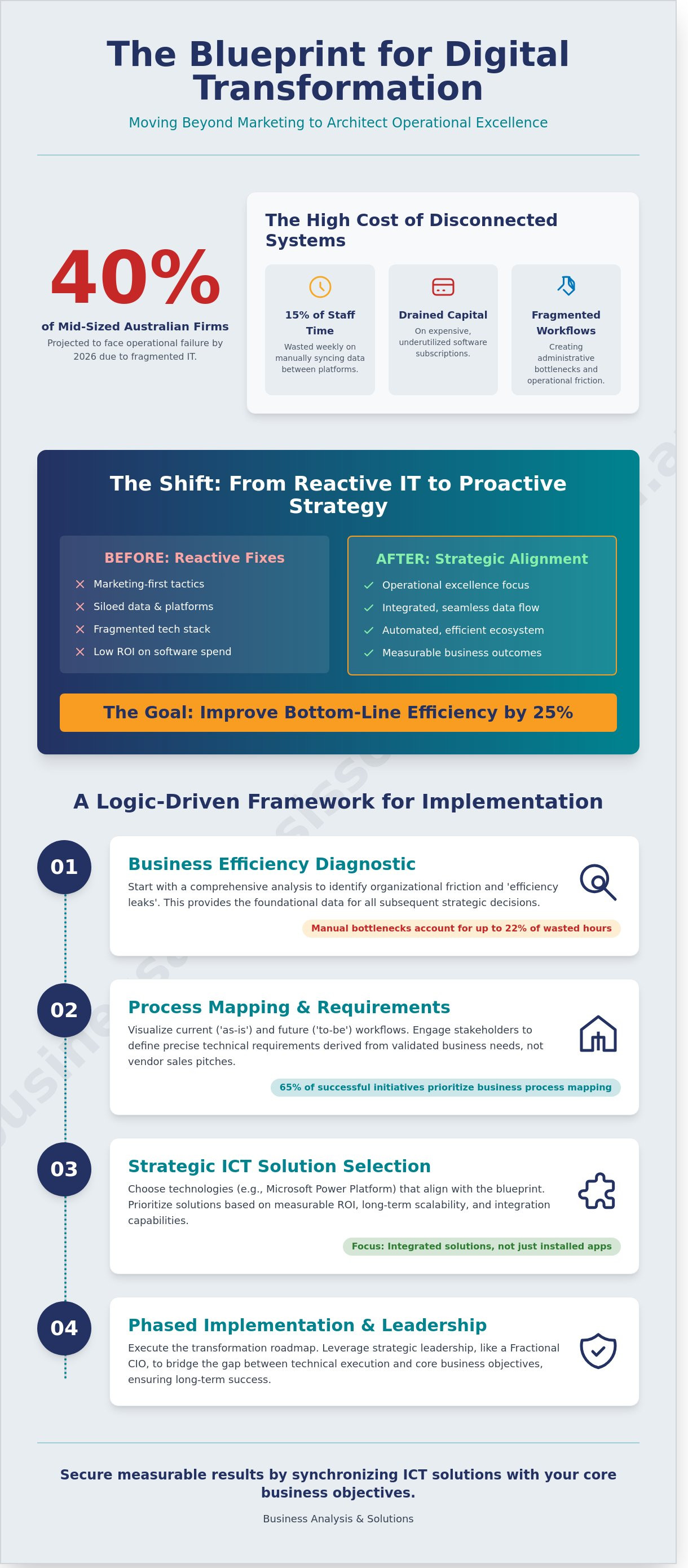
By 2026, a fragmented IT environment won't just be a minor technical hurdle; it will be a primary driver of operational failure for 40% of mid-sized Australian firms. For a specialist provider like Australian Made Vision, the need for streamlined systems is paramount to maintaining operational precision. Developing a cohesive digital strategy perth businesses can actually execute is no longer optional for those targeting sustainable growth. You probably feel the friction of disconnected systems every day, watching your team manually bridge the gaps between software that refuses to communicate. It's a common frustration to see capital drained by expensive platform subscriptions that remain underutilized because they were never aligned with your actual workflow.
This guide offers a logic-driven blueprint to resolve these inefficiencies and secure measurable results. We'll move past the marketing fluff to focus on the precision of process mapping and requirements elicitation. You'll learn how to architect a transformation roadmap that eliminates wasted software spend and synchronizes your ICT solutions with your core business objectives. We'll outline the exact steps to transition from reactive IT fixes to a proactive, automated ecosystem that improves your bottom-line efficiency by 25% through rigorous strategic alignment.
Key Takeaways
Understand why a robust digital strategy perth businesses implement must move beyond marketing to focus on organization-wide operational excellence and ICT sustainability.
Learn to prioritize process mapping before technology acquisition to ensure every software investment aligns with your specific business architecture.
Discover a logic-driven framework for selecting ICT solutions, such as the Microsoft Power Platform, based on measurable ROI and long-term scalability.
Master a systematic implementation process starting with a comprehensive Business Efficiency Diagnostic to identify and eliminate organizational friction.
Explore how leveraging fractional CIO services provides the strategic leadership necessary to bridge the gap between technical requirements and business objectives.
Table of Contents Defining Digital Strategy: Beyond Marketing to Operational Excellence The Architecture of a Digital Transformation Blueprint Evaluating Strategic ICT Solutions vs. Surface-Level Tactics A Step-by-Step Framework for Implementing Your Digital Strategy Strategic Leadership: Leveraging Fractional CIO Services for Implementation
Defining Digital Strategy: Beyond Marketing to Operational Excellence
Digital strategy is the methodical alignment of technology with organisational efficiency. It's common for executives to conflate digital marketing with digital strategy, yet the two serve vastly different functions. Digital marketing targets customer acquisition through external channels; for those looking to improve their technical SEO and site authority, you can learn more about PurpleCow Digital Marketing. A comprehensive digital strategy perth businesses require focuses on a holistic digital transformation that reshapes internal operations. This distinction is critical for long-term ICT sustainability. Without a logic-rooted framework, technology investments often become reactive rather than proactive.
Effective digital strategy bridges the gap between technical requirements and business goals. It translates complex IT capabilities into tangible business outcomes. For example, a 2024 Gartner report highlighted that 65% of successful digital initiatives were led by teams that prioritized business process mapping over software selection. This structured approach ensures that every dollar spent on technology contributes directly to the bottom line. It's about building a foundation that supports scale, not just a series of disconnected apps.
The Core Objectives of a Modern Digital Strategy
Operational efficiency stands as the primary pillar of a 2026 digital framework. By automating repetitive workflows, organisations can reduce administrative overhead by up to 30%. Another key objective is improving data visibility. When data flows seamlessly between departments, executive decision-making becomes grounded in evidence. Future-proofing is also vital. A well-designed digital strategy perth firms implement allows for the rapid adoption of emerging technologies, such as edge computing or advanced AI, without disrupting existing core systems.
Why 'Marketing-First' Strategies Often Fail
Many organisations fall into the trap of implementing customer-facing tools without back-end integration. This marketing-first mindset often results in fragmented technology stacks. These silos create administrative bottlenecks where staff spend 15% of their week manually syncing data between platforms. Strategic alignment prevents this by ensuring that every technological addition meets a validated business requirement. Solutions must be integrated, not just installed. When surface-level trends take precedence over infrastructure integrity, the resulting complexity often outweighs the initial gains in customer reach.
The Architecture of a Digital Transformation Blueprint
A digital transformation blueprint serves as the structural foundation for organizational evolution. It's a pragmatic roadmap that aligns technological investment with commercial objectives. Before committing capital to high-cost software, leaders must understand the current state of their operations. This alignment ensures that every dollar spent contributes directly to the Digital Strategy Outcomes Framework, providing a benchmark for success in the Western Australian market. Without this architectural plan, technology adoption becomes fragmented and fails to deliver a measurable return on investment.
Process Mapping: The Foundation of Strategy
Visualizing workflows is the first step to identifying redundancies. Many firms find that manual bottlenecks account for up to 22% of wasted administrative hours. By utilizing strategic business analysis consultancy in Perth driving efficiency in 2026, organizations can document 'as-is' processes with clinical precision. This transparency allows for the identification of 'efficiency leaks' where data is siloed or duplicated. Transitioning to a 'to-be' state requires more than just new tools; it requires a structural redesign of how work flows through the company. It's about creating a lean operational reality that supports a robust digital strategy perth businesses can scale.
Defining Requirements and ICT Solutions
Technical specifications must be born from business needs, not the other way around. Stakeholder engagement is critical during requirements elicitation to ensure the final solution addresses actual pain points. When planning an automation implementation, the focus stays on documented business objectives. This methodical approach prevents 'feature creep' and ensures that the digital strategy perth companies implement remains lean and effective. Clarity in requirements reduces project rework by an average of 30%, according to industry standards. Every technology choice must serve a documented purpose that is understood by both the technical team and the executive board.
If your current systems feel disjointed or lack integration, professional business analysis can provide the clarity needed to untangle these complexities. We focus on finding the right solution, not the easiest one, ensuring your ICT infrastructure is ready for the demands of 2026.
Evaluating Strategic ICT Solutions vs. Surface-Level Tactics
Effective technology procurement requires a shift from reactive purchasing to proactive architectural design. Organizations often succumb to "shiny object syndrome," where approximately 45% of software features go unused because they don't align with core business objectives. A robust digital transformation strategy framework ensures that every investment yields measurable returns rather than adding to technical debt. When developing a digital strategy perth leaders must prioritize solutions that offer both immediate utility and 10-year scalability. This involves calculating the Total Cost of Ownership (TCO), including a 15% to 22% annual buffer for integration, security updates, and maintenance.
Selection criteria should be rooted in logic and ROI. We recommend a framework that evaluates new tools based on three pillars:
Interoperability: Can the solution share data seamlessly with existing systems via APIs?
Scalability: Will the platform support a 30% increase in transaction volume without a total overhaul?
Strategic Alignment: Does this tool directly solve a requirement identified during the stakeholder engagement phase?
The Power of Integrated Ecosystems
The Microsoft Power Platform stands as a cornerstone for 2026 digital strategies. By 2025, industry benchmarks suggest that 70% of new applications developed by enterprises will use low-code or no-code technologies. This shift allows businesses to bridge the gap between technical requirements and operational objectives without the overhead of traditional custom development. Leveraging integrated reporting tools like Power BI enables a 20% faster response time to market shifts through real-time, data-driven insights. It's about building a foundation that allows for agile business improvement as market conditions evolve.
Tactical vs. Strategic ICT Thinking
Tactical thinking addresses isolated pain points, such as adopting a standalone project management app that doesn't communicate with the finance system. This creates data silos and manual entry errors. Strategic thinking focuses on a unified architecture that supports multiple business functions. A cohesive digital strategy perth firms implement today determines their organizational agility in 2026. Moving from disconnected apps to a unified ecosystem can increase employee productivity by 32% by reducing the cognitive load of switching between disparate interfaces. We focus on building a roadmap where every technical component serves a broader organizational purpose, ensuring that the technology works for the business, not the other way around.
A Step-by-Step Framework for Implementing Your Digital Strategy
Translating high-level vision into operational reality requires a disciplined approach. In the context of a digital strategy perth, businesses must move beyond conceptual planning toward a structured, five-step execution framework. A 2024 report from the Australian Bureau of Statistics indicated that only 35% of businesses successfully scale their digital initiatives without a formal framework; we eliminate this risk through a methodical process.
Step 1: Conduct a comprehensive Business Efficiency Diagnostic to identify bottlenecks.
Step 2: Engage stakeholders early to secure organisational buy-in.
Step 3: Develop a Digital Transformation Blueprint that outlines specific technical requirements.
Step 4: Execute phased implementation through rigorous project management.
Step 5: Monitor performance using real-time data to iterate on the solution.
Phase 1: Diagnostic and Discovery
Precision begins with data. We start by identifying core challenges through quantitative data analysis and structured interviews with key personnel. This process establishes a clear baseline for current technology performance. By 2026, firms using an effort versus impact matrix to prioritise initiatives see a 40% faster ROI on their initial investments. We map every existing process to ensure the digital strategy perth organisations adopt is grounded in current operational reality rather than assumptions. This stage focuses on requirements elicitation, ensuring every technical choice serves a specific strategic goal.
Phase 2: Execution and Change Management
Successful ICT solution delivery hinges on meticulous project management. We focus on the human element because technology alone doesn't drive growth; adoption does. A 2024 Prosci report found that projects with excellent change management are six times more likely to meet objectives. We implement automation projects with a focus on seamless integration, ensuring new tools don't create data silos. Our methodology bridges the gap between technical requirements and business objectives to deliver tangible value. By maintaining a steady, methodical rhythm, we ensure that digital transformation feels like a controlled evolution rather than a disruptive event.
Optimise your operations with a proven framework for digital strategy designed for long-term growth.
Strategic Leadership: Leveraging Fractional CIO Services for Implementation
Small and medium enterprises often face a leadership vacuum when it relates to high-level technology integration. While a CEO focuses on market expansion and a CFO manages the balance sheet, the technical roadmap is frequently left to junior staff or external vendors with misaligned incentives. By 2026, the gap between having a conceptual plan and executing a functional architecture will determine which firms thrive. A Fractional CIO bridges this gap by providing executive-level IT guidance on a flexible basis. This approach ensures your digital strategy perth initiatives are led by someone who understands both the server room and the boardroom.
The Fractional CIO model allows businesses to access strategic direction without the $250,000 plus annual salary commitment of a permanent hire. It's a pragmatic solution for executing a robust digital strategy perth businesses can rely on for long-term stability. This leadership ensures that technology investments aren't just costs, but are calibrated to drive specific, measurable business outcomes.
Bridging the Gap Between Vision and Reality
A seasoned leader provides the technical authority to vet vendors and solutions, ensuring that every software purchase serves a specific business objective. Industry data suggests that 70% of digital transformations fall short of their goals because of a lack of executive alignment. A Fractional CIO mitigates this risk by maintaining a strict focus on your evolving business goals. They act as a bridge between technical requirements and commercial outcomes. This oversight reduces the likelihood of project failure and prevents the accumulation of technical debt that often plagues unguided implementations.
Effective implementation requires more than just technical knowledge; it demands a structured approach to change management. Our experts focus on three primary areas during implementation:
Vendor Accountability: Ensuring that third-party providers meet 100% of the functional requirements defined in the strategy phase.
Strategic Alignment: Continuously adjusting the technical roadmap to reflect changes in the competitive landscape.
Risk Mitigation: Identifying potential security or operational bottlenecks before they impact the bottom line.
Next Steps for Your Organisation
Your journey toward an optimized digital environment begins with a Business Efficiency Diagnostic. This assessment evaluates your current state against industry benchmarks and identifies immediate opportunities for cost reduction. With a 20-year veteran perspective in business analysis, our team applies a methodical approach to every engagement. We don't guess; we use data to drive decisions. This logic-based strategy ensures your organisation doesn't just adopt new technology, but masters it to achieve a measurable return on investment.
The transition from planning to results requires a partner who values precision over marketing hype. Let's move beyond the planning phase and start delivering results through structured, expert leadership. Contact us today to schedule your diagnostic assessment and secure your business's future in the 2026 digital economy.
Future-Proofing Your Business Architecture for 2026
Building a robust digital strategy perth leaders can rely on for 2026 requires moving past surface-level software fixes. You've seen how integrating operational excellence with a structured ICT blueprint transforms a company from reactive to resilient. By 2026, the distinction between business goals and technical execution will effectively disappear. Success hinges on a logic-based framework that prioritizes strategic alignment over temporary trends. You don't have to navigate these organizational complexities alone.
Business Analysis Solutions brings over 20 years of industry experience to this process. We specialize in bridging the gap between complex technical requirements and core business objectives. Our meticulous approach ensures every ICT investment delivers a measurable return on investment. A structured, 5-step implementation framework provides the clarity needed to scale efficiently. This methodology replaces ambiguity with precision, ensuring your technology stack supports long-term growth rather than creating new bottlenecks.
Take the first step toward optimizing your operations today. Book a Business Efficiency Diagnostic to start your digital strategy journey and gain the analytical partnership your growth requires. Your path to a streamlined, high-performance future starts with a single, data-driven decision.
Frequently Asked Questions
What is the difference between an IT strategy and a digital strategy?
An IT strategy manages the hardware and maintenance required for daily operations. Conversely, a digital strategy focuses on business transformation by aligning technology with core objectives. It isn't about the hardware; it's about the value generated. For a digital strategy Perth businesses can rely on, the focus shifts from maintaining infrastructure to driving 15% to 20% increases in organizational efficiency through strategic technological investment.
How long does it take to develop a digital transformation blueprint?
A digital transformation blueprint typically requires four to eight weeks to complete. This 56 day window allows for deep-dive discovery sessions and process mapping across all departments. We conduct an audit of current ICT solutions to ensure the roadmap is realistic. By the 8th week, you'll have a sequence for implementation that targets high-impact automation opportunities to reduce manual workloads by 30%.
Do we need a digital strategy if we are a small business?
Small businesses don't have the luxury of wasted resources, so they require a digital strategy to ensure 100% of their technology spend delivers a measurable return. Without a plan, firms often fall into "random acts of technology," purchasing software that fails to integrate. A structured strategy allows a 10 person team to leverage cloud solutions to compete with 50 person enterprises, scaling operations efficiently without a 1:1 increase in overhead.
What is a Business Efficiency Diagnostic?
A Business Efficiency Diagnostic is a data-driven assessment of your 2026 operational workflows and technology stack. It identifies the specific 12% of manual processes that act as bottlenecks to growth. This diagnostic provides an objective view of where your business loses time. It serves as the initial 7 day phase in creating a digital strategy Perth leaders use to improve performance and drive 5% higher profitability.
How does a Fractional CIO help with digital strategy?
A Fractional CIO provides executive technology leadership on a part-time basis, often saving companies 60% compared to a full-time executive salary. They act as a trusted advisor to the CEO by vetting vendors and overseeing ICT projects. They ensure your digital transformation blueprint is executed with 100% accuracy. This role bridges the gap between your 2026 business vision and technical execution without the long-term overhead of a permanent hire.
What role does process mapping play in digital strategy?
Process mapping creates a visual representation of your business workflows to identify exactly where technology adds value. It's impossible to digitize a process that's fundamentally broken. By mapping every step, an analyst can pinpoint inefficiencies that cause a 12% lag in production. This ensures your digital strategy is built on operational reality. It provides a foundation for automation that can reduce error rates by 25% across the organization.



Comments