The Strategic Guide to Business Efficiency: Optimising Operations in 2026
Updated: Apr 21
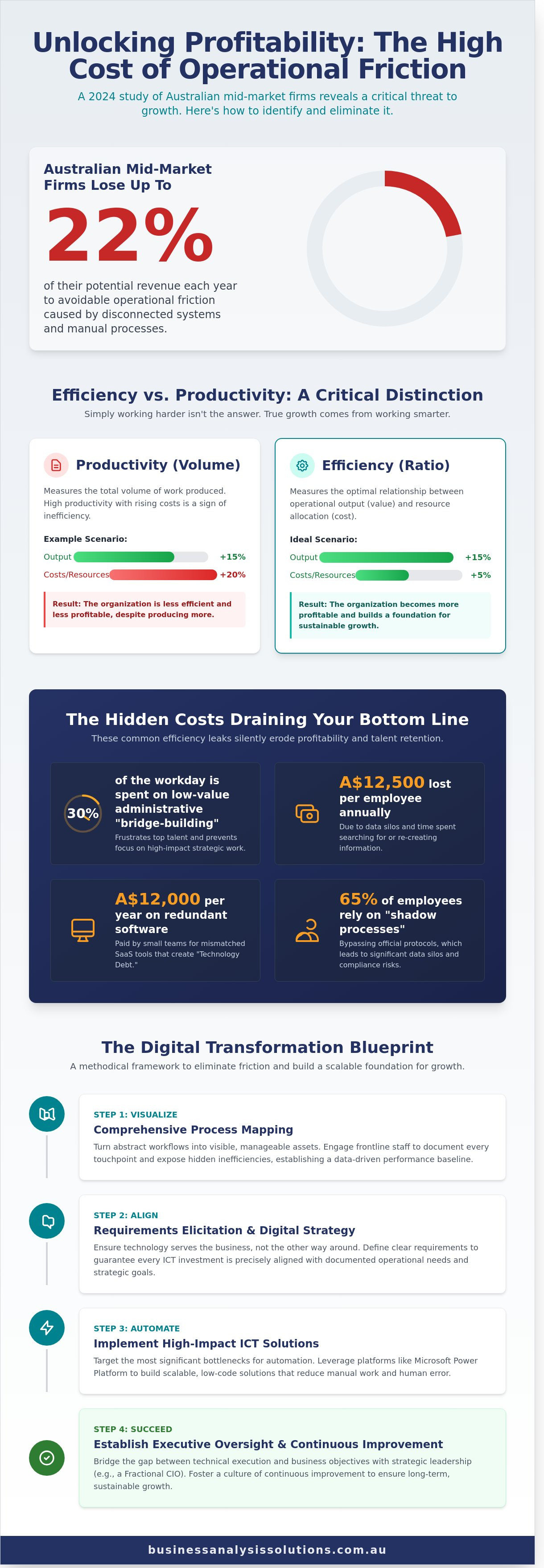
A 2024 study of Australian enterprises found that mid-market firms lose up to 22% of their potential revenue each year to avoidable operational friction. While most leaders acknowledge that business efficiency is the cornerstone of 2026 profitability, many remain trapped by fragmented data across legacy platforms and manual processes that invite human error. You've likely seen how these visibility gaps stall decision-making and force your best talent to spend hours on repetitive data entry rather than strategic initiatives. It's frustrating to watch organisational momentum get throttled by systems that simply can't communicate with one another.
This guide provides a methodical framework to identify those hidden operational bottlenecks and implement strategic ICT solutions that drive sustainable growth. We'll move beyond the surface level to examine how process mapping and requirements elicitation create a clear roadmap for digital transformation. By the end of this article, you'll understand how to reduce operational costs and build scalable processes that no longer rely on individual heroics to succeed.
Key Takeaways
Redefine business efficiency as a catalyst for strategic agility, moving beyond simple time-saving to focus on the optimal relationship between operational output and resource allocation.
Master the methodology of comprehensive process mapping to 'visualise the invisible' and ensure all ICT solutions are precisely aligned with documented business requirements.
Utilise a structured Business Efficiency Diagnostic to identify and seal common 'efficiency leaks' that frequently hinder the performance of modern Australian organisations.
Identify high-impact targets for automation and leverage the Microsoft Power Platform to build a scalable foundation for sustainable organisational growth.
Develop a robust Digital Transformation Blueprint and understand why executive-level oversight, such as a Fractional CIO, is critical for bridging the gap between technical execution and business objectives.
Table of Contents Defining Business Efficiency in the 2026 Landscape The Strategic Pillars: Process Mapping and Digital Alignment Identifying and Auditing Operational Inefficiencies Implementing Automation and ICT Solutions for Scale Developing Your Digital Transformation Blueprint
Defining Business Efficiency in the 2026 Landscape
Business efficiency is the optimisation of workflows to achieve maximum value with minimal waste. In the current 2026 market, this concept has evolved beyond simple time-saving exercises. It now serves as a primary driver of strategic agility. Companies that rely on legacy frameworks often find their operational efficiency metrics declining as decentralised workforces become the standard. By 2025, Australian Bureau of Statistics data indicated that 42% of the workforce engaged in some form of remote or hybrid arrangement. This structural shift requires a move from reactive troubleshooting to proactive process engineering.
Efficiency represents the precise relationship between operational output and resource allocation. It's not about doing more with less; it's about doing the right things with the optimal amount of capital and human talent. Traditional models fail because they assume a linear, centralised flow. In a digital economy, value is created through networked interactions that require high-speed decision-making and minimal friction. Achieving business efficiency requires a methodical approach to identifying bottlenecks before they impact the bottom line.
Efficiency vs. Productivity: A Critical Distinction
Productivity measures the total volume of work produced. Efficiency measures the ratio of input to output. If an Australian mid-market firm increases productivity by 15% but sees costs rise by 20%, it's becoming less efficient. This imbalance leads to organisational burnout and high turnover rates. Strategic alignment ensures that every unit of effort contributes directly to high-value outcomes. Without it, teams simply accelerate toward the wrong destination.
The Economic Impact of Inefficiency
The hidden costs of manual workarounds are substantial. Research from 2024 suggests that Australian businesses lose an average of A$12,500 per employee annually due to data silos and redundant processes. This operational friction does more than drain the bottom line. It erodes stakeholder engagement and frustrates top talent. When staff spend 30% of their day on administrative bridge-building instead of core tasks, retention rates drop. Professionals in 2026 demand streamlined environments that allow them to focus on high-impact work.
In addition to system improvements, providing teams with access to specialized training is a key factor in retention; you can check out Business Academy Southern Africa (BASA) for their 2026 guide on logistics and supply chain management as an example of high-level professional development.
The Strategic Pillars: Process Mapping and Digital Alignment
Operational excellence isn't accidental. It requires a granular understanding of how work flows through an organisation. Process mapping serves as the blueprint for this understanding, turning abstract workflows into visible, manageable assets. Without this visualisation, leaders often attempt to fix symptoms rather than root causes. A 2024 analysis of Australian mid-market firms found that approximately 65% of employees rely on "shadow processes" that bypass official protocols, leading to significant data silos. By documenting every touchpoint, you expose these hidden inefficiencies.
Stakeholder engagement is mandatory during this mapping phase. Frontline staff possess the ground-truth data that executive summaries often miss. Engaging these teams ensures the map reflects reality, not just policy. This collaborative effort establishes a definitive baseline for business efficiency. For example, if a standard procurement cycle currently takes 14 business days, you've identified a hard metric to challenge. This data-driven approach moves the conversation from subjective "feelings" about productivity to objective performance indicators.
Bridging the Gap Between Technology and Business Value
Software should follow process, never lead it. Many organisations fall into the trap of purchasing expensive SaaS platforms and then forcing their staff to adapt to the tool's limitations. This creates "Technology Debt," where the cost of maintaining mismatched systems outweighs the benefits they provide. In Australia, the average cost of redundant software subscriptions can reach A$12,000 per year for small teams. Professional digital strategy consulting ensures that every ICT investment serves a specific, documented business objective. By auditing your current stack against actual operational needs, you can prune unnecessary tools and reinvest those funds into high-impact automation that drives genuine business efficiency.
Requirements Elicitation: Getting the Foundations Right
The transition from "wants" to "needs" is where many projects succeed or fail. Executive vision often focuses on high-level outcomes, while technical teams focus on features. The business analyst acts as the translator, converting strategic goals into precise functional requirements. This process involves rigorous elicitation to ensure the final technical specs support long-term scalability. A U.S. Government Accountability Office report on efficiency emphasizes that structured frameworks are essential for identifying systemic overlaps before they become costly failures. Using a modular digital architecture allows your business to pivot without rebuilding the entire foundation. Engaging a partner for tailored operational analysis ensures these specifications align with your five-year growth plan, preventing the need for a total system overhaul by 2028.
Identifying and Auditing Operational Inefficiencies
The Business Efficiency Diagnostic serves as a rigorous, logical framework for identifying systemic waste within an organization. In 2026, Australian firms lose an estimated A$37,000 per employee annually due to redundant processes and legacy systems that no longer serve their purpose. True business efficiency isn't achieved through superficial changes; it requires a deep dive into the technical and operational layers of the firm. We utilize data-driven insights to isolate bottlenecks, ensuring that every proposed modification is backed by a quantifiable ROI projection before any capital is committed. By mapping the flow of information across departments, leaders can distinguish between high-value activities and "busy work" that drains resources without contributing to the bottom line.
The Symptoms of Operational Friction
Operational friction often manifests as "shadow IT," where departments procure unauthorized software to bypass rigid legacy systems. This leads to fragmented data silos and increased security risks. Recent 2025 industry reports indicate that 42% of Australian mid-market firms struggle with data duplication across disparate platforms, which necessitates costly manual intervention. Additionally, communication breakdowns often occur within integrated communication services frameworks when protocols aren't strictly defined. This lack of cohesion results in delayed decision-making and missed market opportunities, costing some enterprises up to 15% of their potential annual turnover.
Conducting an Internal Efficiency Audit
A successful audit begins with a systematic review of existing workflow documentation to identify where theory diverges from reality. This process requires objective analysis rather than anecdotal evidence. Stakeholder engagement is critical during this phase to ensure the audit captures the lived experience of the workforce.
Structured Interviews: Conduct sessions with department heads to uncover "pain points" that automated data logs might miss.
Process Mapping: Visualize current state workflows to identify unnecessary hand-offs or approval loops that add zero value.
Risk-Benefit Matrix: Evaluate proposed changes based on their implementation cost versus projected A$ savings over a 24-month horizon.
This methodical approach ensures that interventions are prioritized based on their direct impact on business efficiency. By quantifying the cost of inaction, such as the A$12,500 monthly loss typical of inefficient procurement cycles, organizations can build a compelling case for strategic transformation. Precision in the audit phase prevents the misallocation of capital toward solutions that don't address the root cause of the friction. It's about finding the right solution, not the easiest one.
Implementing Automation and ICT Solutions for Scale
Achieving sustainable business efficiency requires a clinical approach to technology adoption. We identify automation targets by mapping processes that consume more than 15 hours of manual labour per week or show error rates exceeding 4.2%. By 2026, the Microsoft Power Platform has become the primary engine for Australian mid-market firms seeking to scale without proportional headcount increases. It bridges the gap between raw data and actionable outcomes through Power BI and automated workflows via Power Automate. We measure success by comparing post-implementation cycle times against documented 2025 baselines; a successful deployment should yield a minimum 25% reduction in processing time within the first six months. Managing this transition requires a structured change management framework because 70% of digital transformations fail due to poor user adoption rather than technical flaws.
Low-Code vs. Custom Solutions: Making the Choice
Selecting the right architecture is a financial decision as much as a technical one. For small business owners, consulting with The Bucket List Accountant can clarify how to manage Capex and Opex effectively while scaling. Leveraging existing Microsoft 365 environments often reduces initial capital expenditure by 60% compared to custom-built software. Custom software projects in Australia frequently overrun budgets by 45% because they attempt to reinvent standard business logic. We focus on interoperability, ensuring new automations communicate with legacy ERP systems through secure APIs. This prevents data silos and maintains a single source of truth across the enterprise.
Future-Proofing Through ESG and Sustainability
Operational strategy in 2026 is inseparable from environmental responsibility. Understanding how ESG in 2026 impacts your bottom line is vital for long-term viability. Efficient data management reduces digital waste, which currently accounts for approximately 4% of global greenhouse gas emissions. By pruning cloud instances and streamlining data storage, firms lower energy consumption and operational costs simultaneously. Sustainable operations aren't just a compliance requirement; they drive a 12% increase in long-term profitability by attracting ethical investment and reducing resource waste.
To ensure your technology stack delivers measurable results, you need a roadmap that aligns with your specific operational goals. Consult with our business analysis experts to define your automation strategy and improve your business efficiency today.
Developing Your Digital Transformation Blueprint
A Digital Transformation Blueprint is the definitive roadmap for integrating technology into every area of a business. This document serves as the architectural foundation for long-term business efficiency by aligning technical infrastructure with specific commercial goals. Without a formalised blueprint, organisations risk fragmented software adoption that creates data silos and increases operational friction. A successful framework includes a detailed audit of current processes, a target state architecture, and a clear sequence for systems integration. It ensures that every technical decision supports the overarching objective of streamlined operations.
The Role of Fractional CIO Services
Australian SMEs frequently face a gap in executive IT leadership, as the average salary for a full-time CIO in Sydney or Melbourne often exceeds A$280,000. Fractional CIO services provide access to this high-level expertise without the prohibitive overhead. These advisors deliver strategic technology solutions that support national market expansion, ensuring that IT infrastructure can scale alongside revenue growth. By facilitating requirements elicitation and strategic alignment, they bridge the gap between boardroom financial objectives and technical department deliverables. This ensures that every technology project remains focused on driving measurable performance outcomes.
Next Steps: From Strategy to Execution
Securing budget and buy-in for efficiency initiatives requires a data-driven business case. For instance, demonstrating how a A$75,000 investment in automated workflow management will reduce manual data entry errors by 45% provides the clarity boards need to approve funding. Execution should follow a phased rollout to minimise operational disruption. Implementing changes in structured 90-day sprints allows teams to adapt to new tools without compromising daily output. This methodical approach transforms business efficiency from a one-off project into a core organisational competency.
Moving from strategy to execution requires a fundamental shift in mindset. You're not just installing software; you're building a culture of continuous improvement. Finalising the roadmap involves setting specific KPIs for each phase, such as a 20% reduction in customer response times within the first six months of implementation. This disciplined focus on execution ensures that the digital transformation remains a vehicle for strategic growth rather than a source of technical debt. By 2026, the most resilient firms will be those that treat their digital roadmap as a living document, constantly refined to meet evolving market demands and technological shifts.
Securing Operational Resilience for the 2026 Fiscal Year
Achieving peak business efficiency in 2026 requires more than just adopting new software. It demands a rigorous audit of existing operational bottlenecks and strategic alignment between your objectives and technical infrastructure. Research indicates that firms failing to bridge the gap between business requirements and ICT implementation risk a 15% decline in operational ROI compared to peers using structured methodologies. Success hinges on a clear digital transformation blueprint that prioritises process mapping and scalable automation.
Business Analysis Solutions brings over 20 years of industry experience to help your organisation navigate these complexities. We specialise in bridging technical and business requirements to ensure every digital investment delivers measurable value. Our proven Digital Transformation Blueprint methodology provides the clarity needed to untangle legacy processes and implement high-performance systems. We've helped numerous Australian enterprises transform their cost centres into value drivers.
Don't let operational ambiguity stall your progress. Book a Business Efficiency Diagnostic with our expert consultants to secure your competitive advantage. We're ready to help you build a more resilient and profitable future.
Frequently Asked Questions
What is the first step to improving business efficiency?
The first step to improving business efficiency is conducting a comprehensive diagnostic audit to identify current operational bottlenecks. You can't fix what you haven't measured. By engaging in detailed process mapping, stakeholders identify exactly where resources are wasted. In 2024, the International Institute of Business Analysis reported that 72% of successful transformations began with this baseline assessment. This initial phase ensures that subsequent interventions target high-impact areas rather than superficial symptoms.
How do I measure business efficiency in a service-based industry?
You measure efficiency in service industries by calculating the ratio of billable utilisation against total labour costs. For Australian firms, a target utilisation rate of 75% or higher typically indicates healthy operational flow. You should also track the cost-to-serve for specific client segments to identify low-margin activities. In 2025, mid-sized Australian consultancies using these specific metrics saw a 14% increase in profit margins. Tracking these KPIs provides the data needed to refine service delivery models.
Can automation really replace manual process mapping?
Automation software can't replace manual process mapping because it lacks the ability to capture nuanced stakeholder insights and informal workarounds. While task mining tools provide data, they don't explain the logic behind inefficient habits. A 2024 study by Gartner found that 60% of automation projects fail when they bypass the manual discovery phase. You need human analysis to ensure you're automating an optimised process rather than simply accelerating an existing mess.
What is the difference between a business analyst and a CIO?
A Business Analyst focuses on eliciting specific requirements and optimising individual processes, while a Chief Information Officer manages high-level technology strategy and governance. The analyst works at the granular level to bridge the gap between business needs and technical solutions. Conversely, the CIO oversees the entire ICT budget, which averaged 3.2% of total revenue for Australian enterprises in 2023. Both roles are essential for ensuring that technical investments align with broader corporate objectives.
How long does a typical business efficiency diagnostic take?
A typical business efficiency diagnostic takes between 4 and 8 weeks to complete for a standard mid-market Australian firm. This timeframe allows for thorough stakeholder interviews, data collection, and the validation of current-state models. Larger organisations with multiple departments might require up to 12 weeks to ensure every functional area is accurately represented. This structured timeline ensures that the final recommendations are based on verified data rather than rushed assumptions.
Is business efficiency only about cutting costs?
Business efficiency is about value maximisation and strategic resource allocation, not just cost reduction. While lowering overheads is a common outcome, the primary goal is often increasing output without increasing headcount. For instance, an efficient firm might reinvest a 10% operational saving into research and development to drive future growth. True efficiency ensures that every A$1 spent generates the highest possible return on investment across all business units.
What are the biggest risks when implementing new ICT solutions?
The biggest risks when implementing new ICT solutions are poor requirements elicitation and a lack of user adoption. When requirements aren't clearly defined, scope creep can increase project costs by 25% or more. Additionally, if the end-users don't understand the new system's value, the adoption rate will plummet. Managing these risks requires a structured change management plan and a clear alignment between the new technology and existing business workflows.
How does digital strategy impact overall business growth?
A robust digital strategy impacts growth by providing a scalable roadmap that aligns technical capabilities with commercial goals. According to 2024 data from the Australian Bureau of Statistics, businesses with high digital engagement were 50% more likely to report increased productivity. By integrating fragmented systems, you create a seamless data flow that allows for faster decision-making. This strategic alignment ensures that technology acts as a catalyst for expansion rather than a bottleneck.



Comments