Digital Transformation Blueprint for Business: The 2026 Strategic Framework
Updated: Apr 20
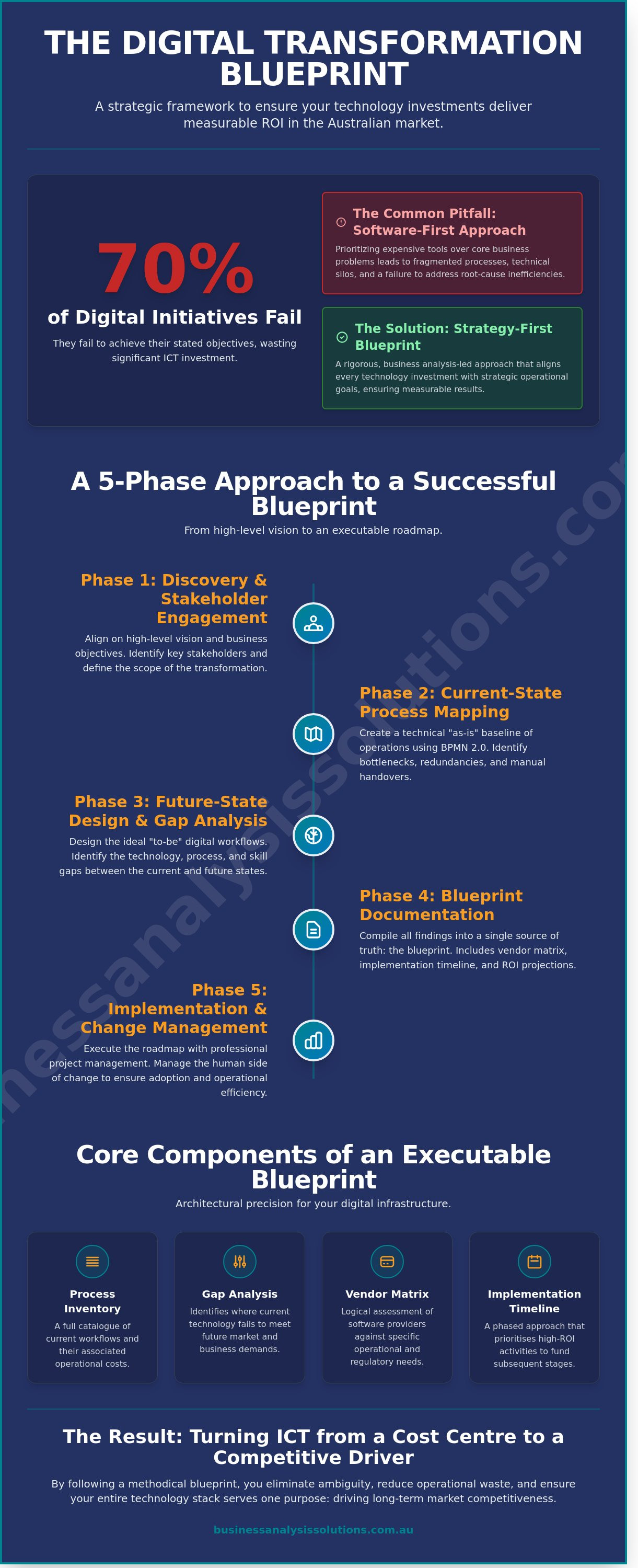
Approximately 70% of digital initiatives fail to achieve their stated objectives because they prioritise software over strategy. In the Australian market, where ICT spending is projected to exceed A$130 billion by 2025, the cost of a misaligned digital transformation blueprint for business is simply too high for any leadership team to ignore. You've likely seen how fragmented processes and technical silos create friction rather than flow. It's a common frustration when expensive technical tools don't solve the core business problems they were meant to address.
This article provides a structured framework to ensure your technology investments deliver tangible value. We'll show you how a rigorous, business analysis-led approach eliminates ambiguity and aligns every tool with your operational goals. We're moving beyond the buzzwords to examine the specific requirements elicitation and process mapping techniques needed for a successful 2026 strategic rollout. You'll gain a clear roadmap to reduce operational waste and ensure your ICT budget translates into measurable efficiency. By following this methodical approach, you can transform ICT from a cost centre into a driver of long-term Australian market competitiveness.
Key Takeaways
Understand why the 2026 landscape demands a shift from mere technology adoption to a rigorous digital transformation blueprint for business that ensures strategic alignment of all ICT resources.
Learn to bridge the gap between high-level vision and day-to-day execution by mapping current-state inefficiencies directly to future-state digital solutions.
Discover how to conduct a technology stack audit to evaluate the utility and ROI of your existing investments within the Australian business environment.
Master a structured, five-phase methodology for developing an executable framework, moving from stakeholder engagement to granular process mapping.
Identify the critical roles of professional project management and change management in transforming strategic documentation into measurable operational efficiency.
Table of Contents Defining the Digital Transformation Blueprint for Business in 2026 The Core Components of an Executable Digital Blueprint Strategy vs. Blueprint: Bridging the Gap Between Vision and Execution A 5-Phase Approach to Developing Your Digital Transformation Blueprint Implementing the Blueprint: Turning Documentation into Operational ROI
Defining the Digital Transformation Blueprint for Business in 2026
A digital transformation blueprint for business serves as a rigorous technical and operational roadmap. It maps current-state inefficiencies directly to future-state digital solutions. By 2026, the focus has shifted from mere technology adoption to the total strategic alignment of ICT resources. This document is the difference between surviving and leading in a volatile market. Digitalizing involves converting manual processes into digital formats; transformation, however, requires a complete reimagining of the business model. BCG research confirms that 70% of digital initiatives fail to achieve their intended ROI. A blueprint mitigates this risk by establishing clear benchmarks and accountability structures. It ensures that every dollar of a A$500,000 technology budget produces a measurable result.
The Evolution of Digital Strategy
Australian businesses have moved past siloed software acquisitions. They now embrace integrated ecosystem thinking. AI-native workflows in 2026 demand a structured planning document to manage data flow across disparate platforms. The 'Efficiency First' mandate in the Australian market, influenced by fluctuating labour costs and a 2.5% productivity gap identified by the Productivity Commission, requires every investment to be justified through data. Firms aren't just buying software to solve isolated problems. They're building interconnected environments where data moves seamlessly from customer acquisition to final delivery. This evolution demands a blueprint that prioritises interoperability over individual features. To see how a creative digital agency can help you unify these touchpoints into a coherent system, learn more about OS.labs.
Why 'Blueprint' Implies Architectural Precision
Business architecture requires the same level of detail as physical construction. You wouldn't commission a A$10 million commercial facility without a structural plan; your digital infrastructure shouldn't be any different. This document acts as a single source of truth for stakeholders, developers, and management. It eliminates ambiguity during the automation implementation phase. By defining requirements early, companies avoid the technical debt that plagues 65% of mid-market Australian firms. The blueprint ensures that the technical execution remains anchored to the original business objectives, preventing the common trap of technology for technology's sake. It provides a logical sequence for deployment, ensuring that foundational systems are stable before layering complex AI or automation tools on top.
A comprehensive blueprint includes:
Process Inventory: A full catalogue of current workflows and their associated costs.
Gap Analysis: Identification of where current technology fails to meet 2026 market demands.
Vendor Matrix: A logical assessment of software providers against specific Australian regulatory requirements.
Implementation Timeline: A phased approach that prioritises high-ROI activities to fund subsequent stages.
The Core Components of an Executable Digital Blueprint
A high performing digital transformation blueprint for business transitions from a conceptual vision to a technical roadmap through four critical pillars. Success isn't found in adopting the newest software; it's found in the rigorous alignment of operational reality with technological capability. This requires a granular audit of every touchpoint within the organisation to ensure that every investment serves a specific strategic purpose.
Process Mapping: The Foundation of Transformation
We use BPMN 2.0 standards to create a technical "as-is" baseline of your current operations. This visualisation identifies exactly where manual handovers create latency or where redundant data entry costs the business time. These maps provide the empirical evidence needed to justify investment. Without this clarity, any new software will likely automate existing inefficiencies rather than eliminate them. This structured approach is the primary driver behind a successful digital strategy that delivers a measurable return on investment by 2026.
The blueprint must also include a comprehensive technology stack audit. Many Australian firms currently carry technical debt from legacy systems that no longer serve their strategic goals. We evaluate the utility and ROI of each solution, often finding that consolidating three disparate A$15,000 annual subscriptions into one integrated platform reduces operational friction by 22% or more. This audit ensures the digital transformation blueprint for business remains lean, cost effective, and scalable for future growth.
Stakeholder Alignment and Requirements Elicitation
Requirements elicitation is the process of separating user "wants" from business "needs." We employ methodical workshops to gather both functional requirements, which describe what the system does, and non-functional requirements, which define how the system performs. This precision prevents the common communication gap between executive leadership and technical teams. We prioritise these requirements based on their direct impact on business value, ensuring that the most critical features are delivered first.
Data governance serves as the final safeguard. It establishes protocols for data integrity and security before a single line of code is written or a new platform is procured. By defining who owns the data and how it's protected, you mitigate the risk of a breach that could cost an Australian SME upwards of A$4.6 million per incident. If you're ready to move beyond theory, our team specialises in optimising organisational workflows through this structured methodology. We ensure your data remains a strategic asset rather than a liability, providing a clear path toward a fully digitised future.
Strategy vs. Blueprint: Bridging the Gap Between Vision and Execution
A high-level strategy identifies the destination, yet it rarely provides the turn-by-turn navigation required for daily operations. Strategy focuses on the 'why' and 'what', while a digital transformation blueprint for business serves as the tactical architecture for the 'how'. Without this granular level of detail, organisations fall into the 'Execution Gap'. This is where 70% of digital projects lose momentum because they lack clear process mapping and resource allocation. A strategy might aim to 'improve customer experience', but the blueprint specifies exactly which legacy database must be migrated to a cloud environment by Q3 2026 to achieve that goal. It's the difference between a vision statement and a work order.
The Execution Gap typically occurs due to three specific factors:
Misalignment between executive vision and frontline technical capabilities.
Inadequate documentation of existing 'as-is' processes before implementing 'to-be' solutions.
Failure to allocate specific budget for change management and staff training.
The Role of the Business Efficiency Diagnostic
Effective blueprints don't begin with software procurement. They start with a Business Efficiency Diagnostic. This process uncovers hidden operational costs, such as the A$45,000 annually wasted on manual data entry in a typical mid-sized Australian firm. By quantifying these leakages, you establish a baseline for ROI. The diagnostic moves beyond vague observations; it turns a 'finding' like 'inefficient reporting' into a blueprint 'action item' such as 'automate weekly financial reconciliation using API integrations'. This ensures every dollar of your capital expenditure targets a verified bottleneck rather than a perceived one.
Creating a Scalable Technology Roadmap
Your roadmap must accommodate both current requirements and the technological shifts expected by 2030. Scalability relies on modularity. Leveraging the Microsoft Power Platform allows businesses to build custom solutions that integrate with existing systems without the heavy overhead of traditional software development. This approach balances 'quick wins', like a mobile inspection app deployed in 30 days, with long-term infrastructure stability. A successful digital transformation blueprint for business prioritises interoperability, ensuring that as your Australian enterprise grows, your tech stack expands rather than fractures. It builds a foundation where new AI or automation modules can be plugged in without rebuilding the entire core.
A 5-Phase Approach to Developing Your Digital Transformation Blueprint
Building a robust digital transformation blueprint for business requires a methodology that prioritises logic over trends. Our framework moves through five distinct stages to ensure every investment aligns with your long-term operational goals. By 2026, the Australian market will demand higher levels of interoperability, making this structured approach a necessity for survival.
Phase 1: Internal Discovery and Stakeholder Engagement. We identify the key influencers and decision-makers across the organisation to understand conflicting priorities.
Phase 2: Detailed Process Mapping and Efficiency Analysis. This involves documenting "As-Is" workflows to identify bottlenecks where manual intervention slows down output.
Phase 3: Technology Gap Analysis and Solution Selection. We compare your current stack against future needs, identifying where legacy systems fail to meet 2026 performance benchmarks.
Phase 4: Risk Assessment and Cybersecurity Alignment. We integrate the Australian Cyber Security Centre’s Essential 8 framework to ensure your transformation doesn't create new vulnerabilities.
Phase 5: Final Documentation and Implementation Roadmap. The final output is a sequenced plan that dictates exactly when and how to deploy new assets.
Discovery and Elicitation: Uncovering the Truth
Precision in the discovery phase prevents the costly mistake of digitising an already broken process. We use structured workshops and one-on-one interviews to peel back the layers of daily operations. Elicitation is the proactive process of drawing out requirements from stakeholders through structured interaction rather than merely gathering documented requests. By focusing on the "why" before the "how," we avoid solution bias. This prevents the common error of selecting a software vendor before the underlying business problem is fully quantified.
Future-State Architecture: Designing the Solution
The architecture phase transforms abstract requirements into a visual "To-Be" model. We focus on how technology will automate repetitive tasks, such as data entry or invoice reconciliation, to reclaim billable hours. A critical component is defining integration points between your ERP, CRM, and third-party logistics providers to ensure data flows without friction. We establish clear KPIs, such as a 25% reduction in lead-to-cash cycles, to measure the success of the digital transformation blueprint for business once it goes live. This ensures the project remains focused on delivering a measurable return on investment rather than just technical change.
If you're ready to move beyond guesswork and implement a proven framework, explore our professional business analysis services to start your journey.
Implementing the Blueprint: Turning Documentation into Operational ROI
A digital transformation blueprint for business only delivers value when it moves from a static document to a live operational framework. This transition requires disciplined project management. Without a dedicated lead, complex projects often exceed budgets by an average of 27 percent according to Australian industry benchmarks. Professional oversight ensures that every technical milestone translates into a measurable commercial outcome.
Success depends heavily on cultural adaptation. Leaders must address the human element immediately. Industry data indicates that 70 percent of change initiatives fail because of employee resistance or lack of engagement. Effective implementation requires structured change management, clear communication, and training schedules that align with the new technical architecture. It's about ensuring your team possesses the skills to operate the tools you've built, which is why programs like the Achieve With Nate Movement focus on digital confidence coaching and technology training to bridge the user-capability gap.
Ongoing governance is vital to prevent digital drift. This occurs when systems and processes slowly decouple from the original strategy over time. Regular audits and expert consultancy keep the blueprint relevant as market conditions shift. This prevents the organisation from falling back into inefficient legacy habits. Treating the strategy as a living document ensures your investment continues to yield returns long after the initial launch phase ends.
The Fractional CIO Advantage
Hiring a full-time CIO in Australia often requires a salary investment exceeding A$250,000 annually. Fractional CIO services provide executive-level oversight without that full-time cost. These experts ensure your digital transformation blueprint for business remains aligned with long-term commercial goals. They manage complex ICT procurement and vendor relationships with precision, ensuring that third-party contracts deliver the specific technical requirements identified during the planning phase.
Continuous Improvement and Automation
Automation is a core component of the operational blueprint, not a one-time setup. Businesses must use data from new systems to create a feedback loop. By 2026, 80 percent of successful mid-market firms will use these loops to refine their processes in real-time. This iterative approach identifies bottlenecks before they impact the bottom line. It positions your business to adopt the next wave of innovation with minimal friction. Data-driven refinement ensures your operations remain lean, agile, and ready for future scale.
Securing Your Competitive Advantage Through Precision Execution
The transition from a high-level vision to operational reality requires more than just modern software. Success in 2026 depends on a structured 5-phase approach that aligns technical requirements with core business objectives to eliminate process friction. By following a comprehensive digital transformation blueprint for business, organisations can secure measurable ROI and avoid the 70% failure rate often associated with poorly defined digital initiatives. Precision in requirements elicitation and stakeholder engagement isn't optional; it's the foundation of every successful scale-up project.
Business Analysis Solutions brings over 20 years of specialised expertise to this process. We focus on bridging the gap between complex technical specifications and practical business needs across our national Australian service network. Don't leave your strategic execution to chance when you can rely on a proven methodology that prioritises clarity over ambiguity. We've spent two decades refining the tools necessary to untangle organisational complexities and deliver tangible results for our clients.
Book a Business Efficiency Diagnostic to start your blueprint journey and ensure your organisation is equipped for the challenges of the next decade. We're ready to help you turn complexity into a clear path forward.
Frequently Asked Questions
What is the difference between a digital strategy and a digital transformation blueprint?
A digital strategy defines your high-level objectives, whereas a digital transformation blueprint for business serves as the granular execution map. The strategy outlines your 2026 vision, but the blueprint details specific process mapping and requirements elicitation. It bridges the gap between conceptual goals and technical delivery. You can think of the strategy as the destination and the blueprint as the turn-by-turn navigation system for your internal teams.
How long does it typically take to develop a comprehensive digital blueprint?
Developing a comprehensive blueprint typically requires 8 to 12 weeks of dedicated analysis. This timeframe allows for thorough stakeholder engagement and current-state assessments. For a mid-sized Australian organisation with 50 to 200 employees, the first 4 weeks focus on discovery. The subsequent 8 weeks involve technical architecture design and strategic alignment. Rushing this process often leads to a 30% increase in technical debt during the implementation phase.
Do small businesses really need a formal digital transformation blueprint?
Small businesses require a formal blueprint to prevent the misallocation of limited capital. Without a structured plan, 70% of Australian small-to-medium enterprises fail to achieve their desired return on investment from new software. A blueprint ensures that every A$1 spent on technology directly supports a specific business objective. It provides a scalable framework that grows with the company, preventing the need for costly system replacements 18 months down the line.
What are the common risks of implementing technology without a blueprint?
Implementing technology without a blueprint results in fragmented systems that don't communicate with each other. This lack of integration causes a 25% decrease in operational efficiency due to manual data entry. You also risk significant budget blowouts, as unforeseen technical requirements often emerge mid-project. Without a clear roadmap, businesses frequently find themselves trapped in expensive vendor lock-ins that don't satisfy the actual needs of the end-users or stakeholders.
How much does a digital transformation blueprint cost to develop?
A professional digital transformation blueprint for business typically costs between A$15,000 and A$45,000 for Australian SMEs. This investment covers expert business analysis, process documentation, and solution architecture. While the upfront cost represents about 5% to 10% of the total project budget, it reduces implementation risks by 40%. Investing in a precise blueprint early prevents the compounding costs of fixing structural errors once the development phase has already commenced.
Can a digital transformation blueprint help with Australian cybersecurity compliance?
A blueprint directly supports compliance with Australian standards such as the ASD Essential Eight. By incorporating security requirements into the initial design, you ensure that data privacy is baked into your business processes. This proactive approach helps organisations meet the 2023 Privacy Act amendments and avoid potential penalties. It transforms cybersecurity from a reactive IT task into a core component of your strategic business architecture and risk management framework.
Who should be involved in the creation of the business blueprint?
The creation of a business blueprint requires a cross-functional team led by a senior executive sponsor. You must include department heads from finance, operations, and IT to ensure horizontal alignment across the organisation. Engaging at least 15% of your frontline staff during the requirements elicitation phase is also critical. Their feedback ensures the proposed solutions solve real-world bottlenecks rather than just theoretical problems. This collaborative approach increases internal adoption rates by 50% during rollout.



Comments