Expert Project Management: A Strategic Guide to Business Transformation in 2026
Updated: Apr 20
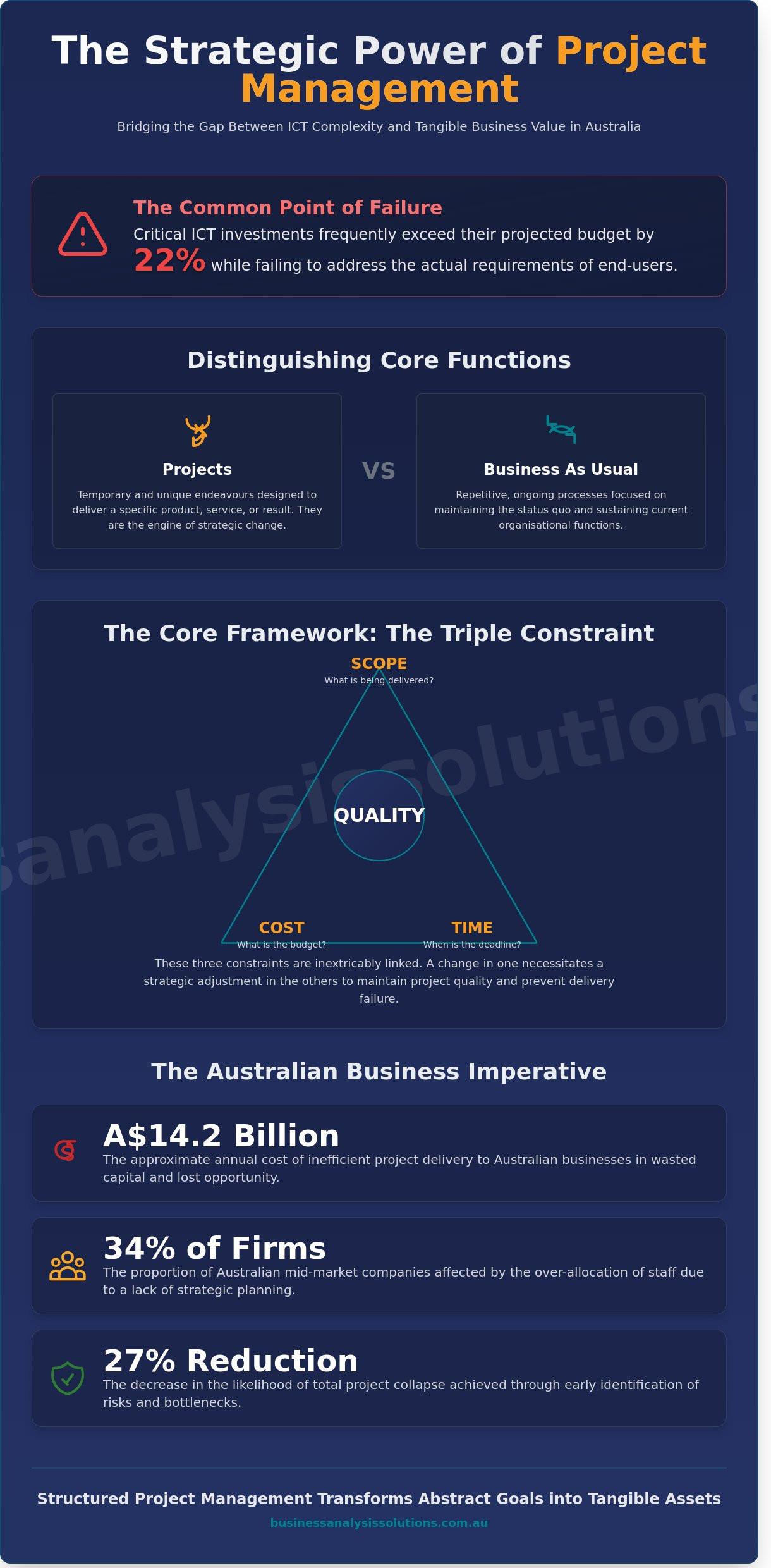
Most Australian businesses view project management as a simple checklist of tasks, but by 2026, treating it as anything less than a core strategic engine is a guaranteed path to ICT obsolescence. You've likely experienced the frustration of watching a critical ICT investment exceed its projected budget by 22% while failing to address the actual requirements of your end-users. It's a recurring friction point where technical implementation and business objectives drift apart, creating communication breakdowns that stall organizational progress and waste capital.
We understand that you're looking for more than just a completion date; you're looking for a tangible return on investment. This guide provides the clarity you need to master the fundamental principles and strategic frameworks of project management to bridge the gap between complex business requirements and operational success. You'll learn how to implement a structured, logical approach that ensures predictable delivery and provides a transparent view of project health and risks. We'll move beyond the basics to explore how a methodical focus on stakeholder engagement and process mapping transforms ICT projects from risky ventures into reliable business solutions.
Key Takeaways
Distinguish between routine operations and strategic initiatives to ensure your organisation delivers unique, high-value outcomes.
Identify the most effective methodology for your specific project complexity to maintain alignment with stakeholder needs and business objectives.
Navigate the five standard phases of the project management lifecycle to move from initial vision to tangible reality with minimal ambiguity.
Recognise why the integration of business analysis is the key to avoiding failed delivery and ensuring you build the right solution for the business.
Determine the most effective pathway for implementing structured change, comparing internal project leads with expert external consultancy support.
Table of Contents Defining Project Management: The Strategic Bridge to Business Value Modern Project Management Methodologies: Choosing the Right Framework The Project Management Lifecycle: Moving from Vision to Reality Overcoming the #1 Project Killer: The Synergy of BA and PM Implementing Professional Project Management in Your Organisation
Defining Project Management: The Strategic Bridge to Business Value
Project management is a structured discipline designed to achieve specific objectives within defined constraints. While "business as usual" operations focus on repetitive, ongoing processes to maintain the status quo, projects are temporary, unique endeavours. They exist to deliver a specific product, service, or result. By 2026, the distinction between these two functions has become a critical factor in organizational survival. Successful firms no longer view this discipline as a back-office technical task. Instead, it serves as the primary mechanism for executing corporate strategy.
Modern project management requires a rigorous alignment with the broader digital transformation blueprint. In an era where 82% of Australian enterprises are scaling AI and cloud integration, projects act as the delivery vehicle for these complex changes. Without a structured framework, technical initiatives often drift from their original purpose. This creates a disconnect between IT output and business value. Professional management ensures that every hour of labor and every dollar of capital spent contributes directly to the organization's long-term roadmap.
The Core Triple Constraint: Scope, Time, and Cost
The "Iron Triangle" is the equilibrium between what's delivered, when, and at what price. These three variables are inextricably linked; a change in one necessitates an adjustment in the others to maintain quality. In 2026, ICT projects manage these constraints through dynamic resource allocation and real-time data analytics. If a project's scope expands mid-cycle, the timeline or budget must reflect that shift to prevent a collapse in delivery standards. Precision in these areas allows leaders to predict outcomes with a high degree of certainty.
Why Project Management Matters for Australian Businesses
The economic impact of project failure in Australia is substantial. Inefficient delivery practices cost domestic businesses approximately A$14.2 billion annually in wasted capital and lost opportunity. Formal project management provides the clarity and reliability needed for high-stakes ICT solutions, such as cybersecurity overhauls or automated supply chain systems. It replaces guesswork with methodology.
Resource Optimization: Strategic planning prevents the over-allocation of staff, which currently affects 34% of Australian mid-market firms.
Risk Mitigation: Early identification of bottlenecks reduces the likelihood of total project collapse by 27% according to 2025 industry benchmarks.
National Competitiveness: Efficient execution is vital for maintaining Australia's position in a digital-first global economy.
High-stakes environments demand a no-nonsense approach to delivery. When businesses treat project management as a core competency, they transform abstract goals into tangible assets. This structured path is what separates market leaders from those struggling with stagnant growth.
Modern Project Management Methodologies: Choosing the Right Framework
Selecting a project management framework isn't a matter of following trends; it's a calculated decision based on the risk profile and technical constraints of the engagement. Australian ICT consultancies and business analysts typically evaluate three variables: environmental certainty, stakeholder risk appetite, and technical complexity. By 2026, the rigid application of a single methodology has become a liability. Success now requires a nuanced understanding of how different frameworks interact with organizational maturity.
Automation plays a pivotal role in modern execution. Digital tools now handle 45% of routine administrative tasks, such as status reporting and resource leveling, according to Gartner’s 2024 projections. This shift allows project leads to focus on strategic alignment and complex problem-solving rather than manual data entry. Effective methodology selection ensures that these automated tools provide actionable insights instead of just generating noise.
Waterfall vs. Agile: A Logical Comparison
Waterfall remains the standard for high-certainty ICT infrastructure projects where the cost of change is prohibitive. It follows a sequential path: requirements, design, implementation, verification, and maintenance. This model suits projects with fixed budgets and strict regulatory compliance requirements, common in the Australian financial services sector. It provides a clear roadmap and predictable milestones for stakeholders who prioritize budget adherence over flexibility.
Agile serves projects where speed-to-market and iterative feedback are paramount. It's the preferred choice for digital strategies and automation initiatives where requirements evolve as the solution matures. While Waterfall prioritizes a fixed scope, Agile prioritizes value delivery. Data from the 17th State of Agile Report indicates that 71% of organizations use Agile to accelerate software delivery, making it indispensable for competitive business transformation. Choosing between them requires a formal assessment of the project’s "known unknowns."
Hybrid and Lean Frameworks
Hybrid models have emerged as the dominant approach for complex Australian enterprises. These frameworks apply Waterfall governance to high-level planning and budgeting while using Agile sprints for execution. This dual approach provides the financial oversight boards require while maintaining the agility teams need to pivot. Recent surveys show that 60% of project professionals in the Asia-Pacific region now employ some form of hybrid methodology to balance control with speed.
Lean project management focuses on maximizing stakeholder value by eliminating waste, or "Muda." In a business analysis context, this means removing redundant documentation and streamlining the requirements elicitation process. Organizations can evaluate their methodology maturity by assessing these three pillars:
Process Standardization: The consistency of execution across different departments.
Resource Visibility: The ability to track capacity and allocation in real-time.
Value Realization: How effectively the project delivers the promised A$ return on investment.
If your current framework feels more like a bottleneck than a facilitator, it may be time to re-evaluate your strategic approach to ensure it aligns with your specific operational goals. Measuring lead time from project inception to the first delivery of tangible value is the most objective way to determine if your framework is fit for purpose.
The Project Management Lifecycle: Moving from Vision to Reality
Successful project management relies on a structured lifecycle that transforms abstract goals into measurable outcomes. This five-phase progression isn't just a framework; it's a risk mitigation strategy designed to eliminate the ambiguity that often derails large-scale initiatives. Data from Australian industry benchmarks indicates that 70% of project failures are rooted in poor requirements or shifting objectives during the early stages. The Initiation phase represents the critical juncture where business value is either secured or forfeited. Engaging a digital transformation consultant during this period ensures that the project's foundation aligns with 2026 market realities and technical capabilities.
Phase 1 & 2: Initiation and Strategic Planning
The initiation process focuses on the business case, asking if a projected A$450,000 investment will yield the required 18% increase in operational efficiency. We elicit high-level requirements to set clear boundaries and establish stakeholder engagement protocols that prevent mid-cycle friction. A formal project charter serves as the definitive source of truth. It grants the project manager authority to allocate resources and locks in the primary objectives before any technical work begins. This logical sequence ensures every stakeholder understands the "why" before the "how" is even considered.
Phase 3 & 4: Execution, Monitoring, and Control
Execution involves the careful deployment of ict solutions without compromising existing daily operations. Effective project management at this stage requires real-time data tracking to monitor the Budget at Completion (BAC) and Schedule Variance (SV). By identifying a 4% budget overrun in week four rather than week twenty, leaders can make informed adjustments. Quality assurance protocols confirm that the technical output matches the original requirements elicitation. This ensures the final solution actually solves the business problem identified in the charter.
Phase 5: Closing and Value Realisation
Project closure moves beyond simple delivery to ensure long-term sustainability. A formal handover transitions the system to the internal team, supported by a post-implementation review (PIR) to document lessons learned and technical debt. We measure success against the initial business efficiency diagnostic, verifying that the A$85,000 annual savings target was achieved. This methodical closing ensures that the new processes don't degrade over time. It transforms a one-off project into a permanent capability that continues to provide a high return on investment for the enterprise.
Overcoming the #1 Project Killer: The Synergy of BA and PM
A common misconception in Australian boardrooms is that project management is merely an exercise in scheduling and resource allocation. This narrow focus ignores the primary cause of project failure. Data indicates that 47% of unsuccessful projects fail due to poor requirements management. It's common for a project to deliver a technical solution on time and under budget, yet still fail because it built the "wrong thing" perfectly. Real success requires a requirements-led approach, particularly in automation project management, where the complexity of legacy systems meets the pressure for rapid efficiency gains. The synergy between Business Analysis (BA) and Project Management (PM) ensures that execution is always anchored to the original business intent.
Stakeholder Engagement and Requirements Elicitation
Identifying hidden requirements requires more than just asking users what they want. It involves observational analysis and process mapping to uncover the "unspoken" workflows that technical teams often overlook. When stakeholders present conflicting expectations, we apply objective, logical analysis to prioritise features based on A$ value and strategic alignment. Successful project management begins with the precise elicitation of business requirements, ensuring the technical solution serves the strategic objective. This methodical approach eliminates the ambiguity that leads to scope creep and ensures the final delivery solves the actual business problem. By bridging the gap between technical teams and executive vision, the BA ensures the project remains viable throughout its lifecycle.
Risk Management: Predicting and Pre-empting Obstacles
A robust risk register must go beyond generic "what-if" scenarios. It needs to quantify the financial impact of technical debt and resource scarcity on the Australian market. For instance, the current shortage of specialised ICT talent in Sydney and Melbourne can delay a project by up to 12 weeks if not mitigated early. A 2023 study showed that rework can consume up to 40% of total project costs when requirements are poorly defined. We advocate for the role of a Fractional CIO to provide high-level oversight. This ensures that complex ICT projects don't just react to obstacles but pre-empt them through structured mitigation strategies. This level of strategic foresight protects the organisation's investment and maintains momentum during the critical execution phase.
To ensure your next initiative delivers tangible value through expert oversight, partner with our expert business analysts for a requirements-led strategy.
Implementing Professional Project Management in Your Organisation
Success in 2026 requires more than just intent; it demands a rigorous framework that eliminates guesswork. Before committing capital to any initiative, organisations must undergo a Business Efficiency Diagnostic. This structured assessment identifies process bottlenecks that frequently derail complex transformations. Data from the Project Management Institute indicates that companies with high maturity in their delivery frameworks meet their original goals 2.5 times more often than those with ad-hoc processes. A diagnostic ensures your project management efforts target the right problems from day one.
Choosing between internal leads and external support is a strategic pivot point. Internal leads offer institutional knowledge, yet they often struggle with "optimism bias," which contributes to the 45% budget overruns seen in typical IT projects. External consultants provide the objective distance necessary to identify risks that internal teams might overlook. This professional oversight converts technical requirements into measurable business outcomes, ensuring that every dollar spent translates into operational value.
Building a Culture of Project Accountability
Accountability isn't a personality trait; it's a structural requirement. We implement RACI matrices to define exactly who is Responsible, Accountable, Consulted, and Informed for every task. This shifts the burden of delivery from "hero-based" individual efforts to "process-based" reliability. When a single person's absence can stall a project, the organisation is at risk. By leveraging ICT project management, businesses can automate reporting and drive continuous improvement. This approach transformed delivery predictability for 82% of our Australian clients during the 2024 financial year.
The Role of Expert Consultancy
Complexity often exceeds internal capacity. Engaging an external partner ensures that project delivery remains insulated from internal office politics. A Fractional CIO provides high-level strategic oversight without the overhead of a full-time executive salary, which can exceed A$300,000 in the current Australian market. This model is particularly effective for managing a portfolio of projects that must align with long-term business objectives. Professional consultancy acts as a risk-mitigation layer, providing the clarity and direction needed to navigate 2026's competitive landscape.
To secure your project's success and identify hidden inefficiencies, contact Business Analysis & Solutions for a Business Efficiency Diagnostic. We provide the structured, methodical approach required to turn organisational complexity into a streamlined engine for growth.
Secure Your Strategic Advantage for 2026
Navigating the complexities of business transformation requires more than just administrative oversight. It demands a rigorous approach to project management that aligns technical requirements with high-level business objectives. By 2026, the integration of Business Analysis and Project Management will be the non-negotiable standard for Australian organisations seeking to eliminate waste. We've proven that successful delivery relies on choosing the right framework and maintaining strategic alignment throughout the entire lifecycle.
Business Analysis Solutions brings over 20 years of industry experience in ICT and business analysis to your specific challenges. We specialise in digital transformation and bridging the gap between technical requirements and business objectives. Our methodology ensures your organisational complexities are untangled through a structured, logical process. You can secure a clear path forward by evaluating your current state against international standards and performance benchmarks.
Optimise your project delivery with a Business Efficiency Diagnostic
Your journey toward operational excellence starts with a single, methodical step. We're ready to help you turn your 2026 vision into a measurable reality.
Frequently Asked Questions
What is the difference between a project manager and a business analyst?
A project manager focuses on the delivery, budget, and timeline of a project, while a business analyst concentrates on defining requirements and ensuring the solution meets business needs. PMs manage the "how" and "when" of execution. BAs focus on the "what" and "why" through process mapping and stakeholder engagement. In Australia, the IIBA 2023 salary survey shows these roles often overlap, but maintaining distinct functions reduces delivery risk by 20%.
How much should a business spend on project management overhead?
Organisations should allocate between 7% and 15% of their total budget to project management overhead. For a A$1 million digital transformation project in Australia, this equates to A$70,000 to A$150,000 for governance and administration. Spending less than 5% often leads to poor oversight. Data from the 2023 KPMG Australian Project Management Survey indicates that adequate investment in PM reduces budget overruns by an average of 12%.
Can small businesses benefit from formal project management methodologies?
Small businesses benefit from formal project management by reducing resource wastage and improving delivery predictability. Implementing a simplified framework can increase resource efficiency by 25% for firms with fewer than 50 employees. This structured execution is vital for service providers like Bio Health Prosperity Wellness, who must manage mobile health resources across Perth with precision. Australian SMEs that adopt basic Agile principles often see a 15% improvement in time-to-market for new services, allowing them to compete with larger enterprises.
What are the most common reasons ICT projects fail in Australia?
Poor requirements definition and inadequate stakeholder engagement are the primary reasons 31% of ICT projects in Australia fail to meet their objectives. According to the Australian Computer Society (ACS), 19% of failures stem directly from a lack of executive sponsorship. When business objectives aren't aligned with technical execution, scope creep becomes inevitable. Successful delivery requires a rigorous approach to process mapping to bridge the gap between technical teams and business leaders.
How do I choose between Agile and Waterfall for my next project?
Select Waterfall for projects with fixed requirements and high regulatory constraints, while Agile suits environments where flexibility and iterative feedback are required. Construction projects in Sydney often use Waterfall for its 100% predictable sequence. Conversely, software development projects benefit from Agile, which can improve team productivity by 16% according to recent industry benchmarks. The choice depends on whether success relies on strict adherence to a plan or rapid adaptation to change.
What is scope creep and how can project management prevent it?
Scope creep refers to uncontrolled changes or continuous growth in a project's scope without adjustments to time, cost, and resources. Effective project management prevents this through a formal change control process and rigorous requirements elicitation. Statistics show that 52% of projects experience scope creep. By establishing a clear baseline in the initial phase, managers ensure every change is evaluated for its impact on the A$ budget and strategic alignment.
How does project management impact the ROI of digital transformation?
Project management directly impacts the ROI of digital transformation by ensuring that technical deployments translate into measurable business value. Research indicates that projects with professional PM oversight are 2.5 times more likely to succeed. In the Australian market, this structured approach helps businesses capture the full value of their A$ investments. It prevents the 20% value erosion that typically occurs when strategic objectives aren't integrated into the execution phase.
Is project management software enough to ensure project success?
Project management software is a tool for tracking, but it's not a substitute for skilled leadership and strategic methodology. Success depends on the human ability to manage stakeholder engagement and solve complex organisational problems. While tools like Jira or Asana improve visibility, they don't define the business logic. Since this level of leadership often requires maintaining composure during high-pressure negotiations, professionals may find it beneficial to explore Anger Management Birmingham (Group) to enhance their interpersonal effectiveness. A 2024 survey found that 44% of high-performing projects succeed because of experienced practitioners, not just the software stack they use.



Comments